- Unit Overview
- Unit A: The Solid Earth
- Get Ready
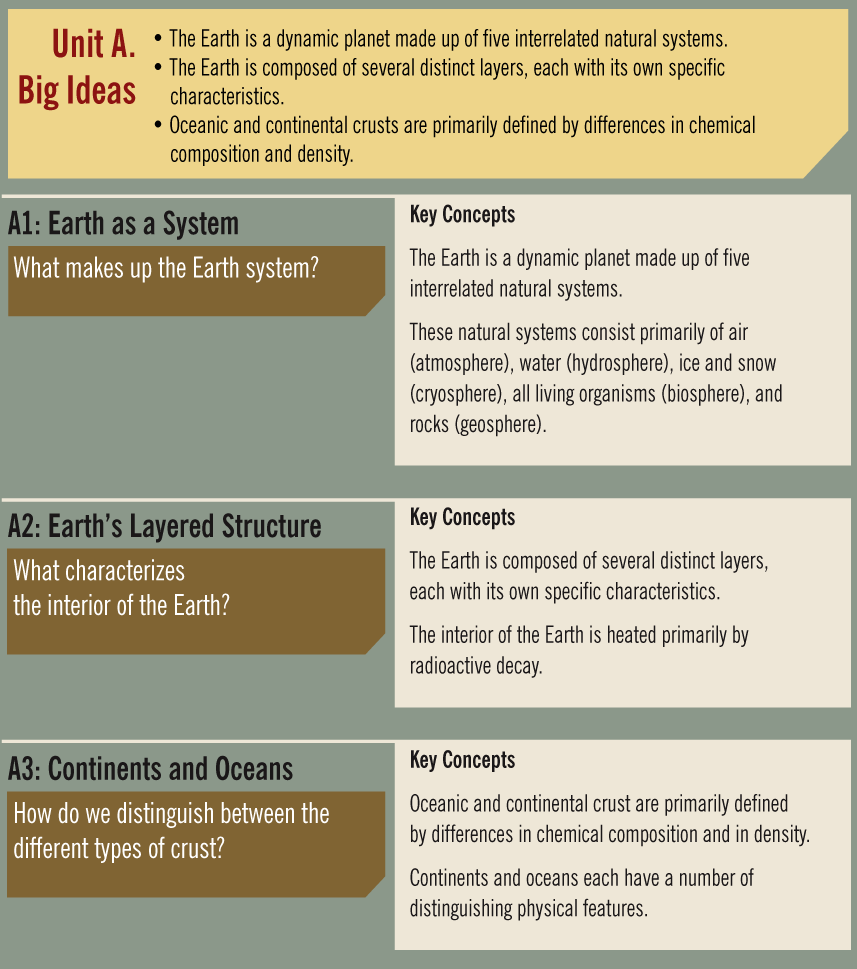
 Unit Overview and Big Ideas
- What Do You Already Know?
- Literacy Link: A Walk on the Bottom of the Sea
- Unit Lessons
- A1: Earth as a System
-
- Guiding Question: What makes up the Earth system?
-
- Key Concepts
- The Earth is a dynamic planet made up of five interrelated natural systems.
- These natural systems consist primarily of air (atmosphere), water (hydrosphere), ice and snow (cryosphere), all living organisms (biosphere), and rocks (geosphere).
-
- A2: Earth's Layered Structure
-
- Guiding Question: What characterizes the interior of the Earth?
-
- Key Concepts
- The Earth is composed of several distinct layers, each with its own specific characteristics.
- The interior of the Earth is heated primarily by radioactive decay.
-
- A3: Oceans and Continents
-
- Guiding Question: How do we distinguish between the different types of crust?
-
- Key Concepts
- Oceanic and continental crusts are primarily defined by differences in chemical composition and in density.
- Continents and oceans each have a number of distinguishing physical features.
-
- Wrap Up
- What Do You Know Now?

 Unit Activity
- Unit B: Plate Tectonics
- Get Ready
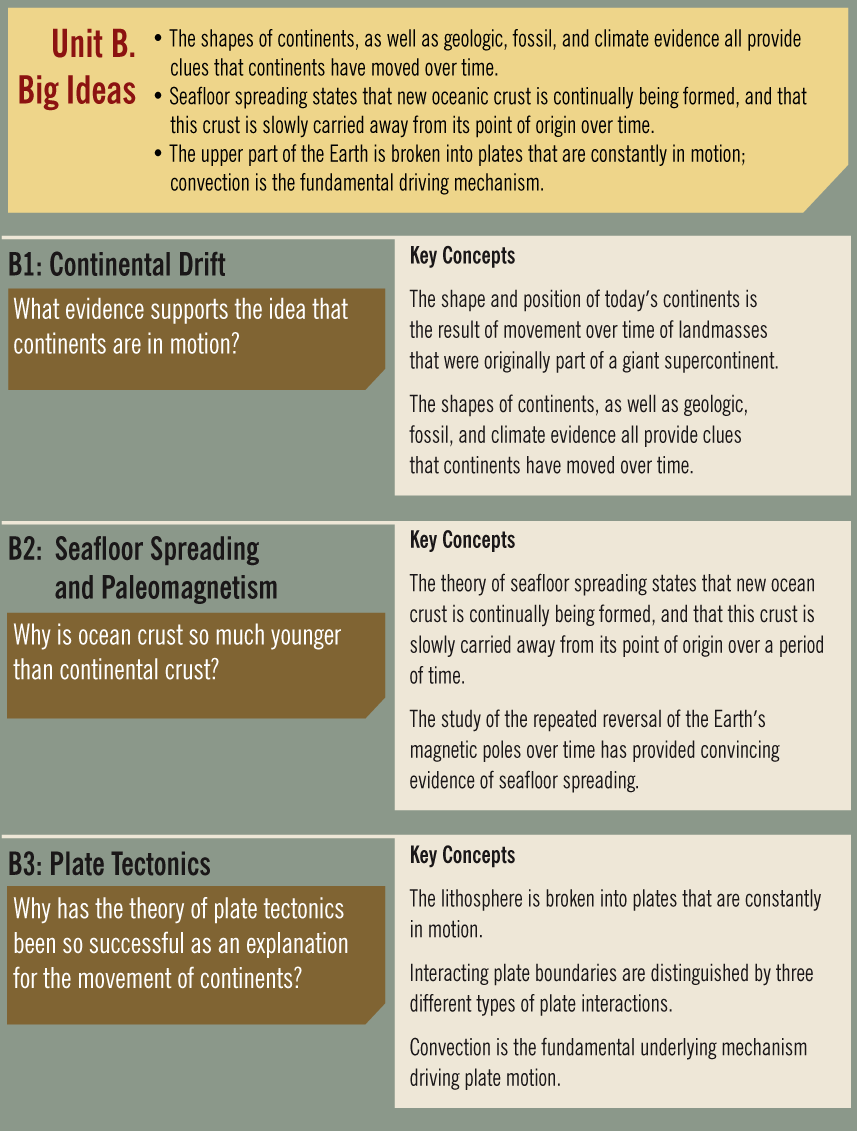
- Unit Overview and Big Ideas
- What Do You Already Know?
- Literacy Link: Antarctica’s Warmer, Not Gentler Past
- Unit Lessons
- B1: Continental Drift
-
- Guiding Question: What evidence supports the idea that continents are in motion?
-
- Key Concepts
- The shape and position of today’s continents is the result of movement over time of landmasses that were originally part of a giant supercontinent.
- The shapes of continents, as well as geologic, fossil, and climate evidence all provide clues that continents have moved over time.
-
- B2: Seafloor Spreading and Paleomagnetism
-
- Guiding Question: Why is ocean crust so much younger than continental crust?
-
- Key Concepts
- The theory of seafloor spreading states that new ocean crust is continually being formed, and that this crust is slowly carried away from its point of origin over a period of time.
- The study of the repeated reversal of the Earth’s magnetic poles over time has provided convincing evidence of seafloor spreading.
-
- B3: The Theory of Plate Tectonics
-
- Guiding Question: Why has the theory of plate tectonics been so successful as an explanation for the movement of continents?
-
- Key Concepts
- The lithosphere is broken into plates that are constantly in motion.
- Interacting plate boundaries are distinguished by three different types of plate interactions.
- Convection is the fundamental underlying mechanism driving plate motion.
-
- Wrap Up
- What Do You Know Now?

 Unit Activity
- Unit C: Minerals and Rocks
- Get Ready
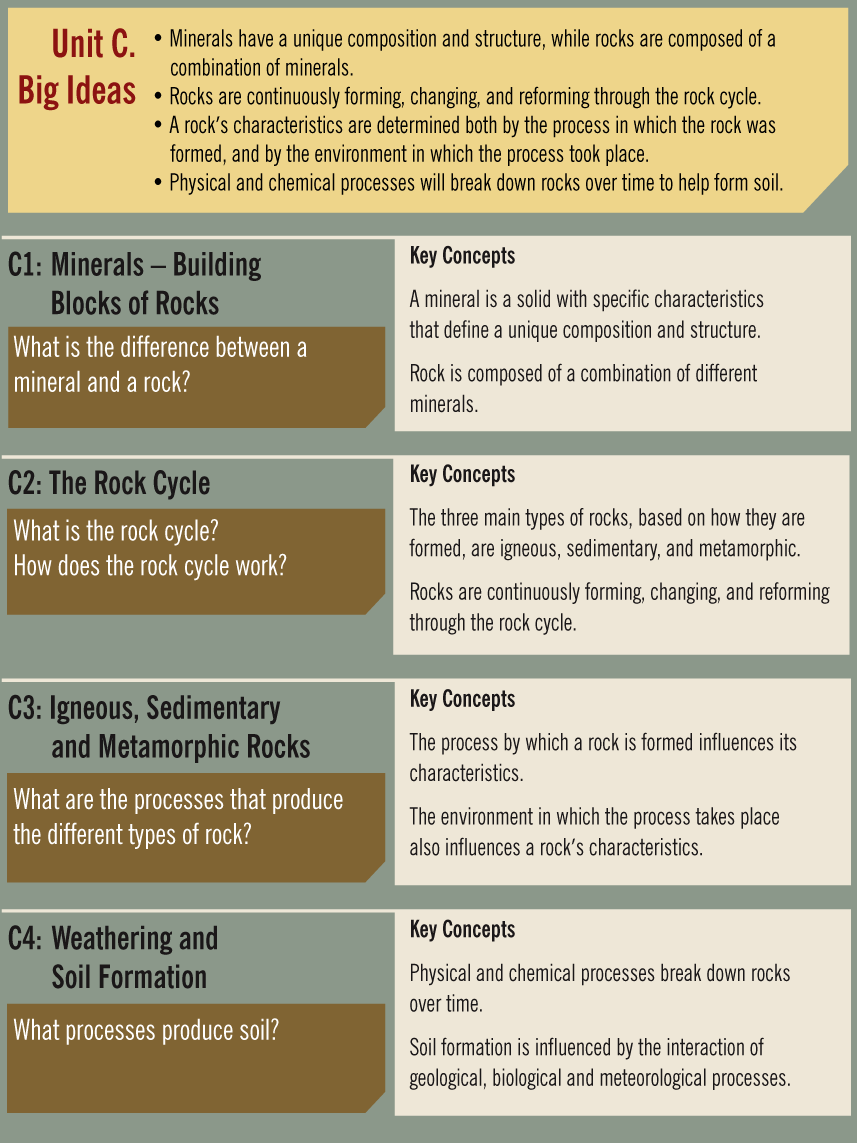
- Unit Overview and Big Ideas
- What Do You Already Know?
- Literacy Link: The Fascination of Marble
- Unit Lessons
- C1: Minerals - Building Blocks of Rocks
-
- Guiding Question: What is the difference between a mineral and a rock?
-
- Key Concepts
- A mineral is a solid with specific characteristics that define a unique composition and structure.
- Rock is composed of a combination of different minerals.
-
- C2: The Rock Cycle
-
- Guiding Questions: What is the rock cycle? How does the rock cycle work?
-
- Key Concepts
- The three main types of rocks, based on how they are formed, are igneous, sedimentary, and metamorphic.
- Rocks are continuously forming, changing, and reforming through the rock cycle.
-
- C3: Igneous, Sedimentary and Metamorphic Rocks
-
- Guiding Question: What are the processes that produce the different types of rock?
-
- Key Concepts
- The process by which a rock is formed influences its characteristics.
- The environment in which the process takes place also influences a rock’s characteristics.
-
- C4: Weathering and Soil Formation
-
- Guiding Question: What processes produce soil?
-
- Key Concepts
- Physical and chemical processes break down rocks over time.
- Soil formation is influenced by the interaction of geological, biological, and meteorological processes.
-
- Wrap Up
- What Do You Know Now?

 Unit Activity
- Unit D: Shaping The Earth
- Get Ready
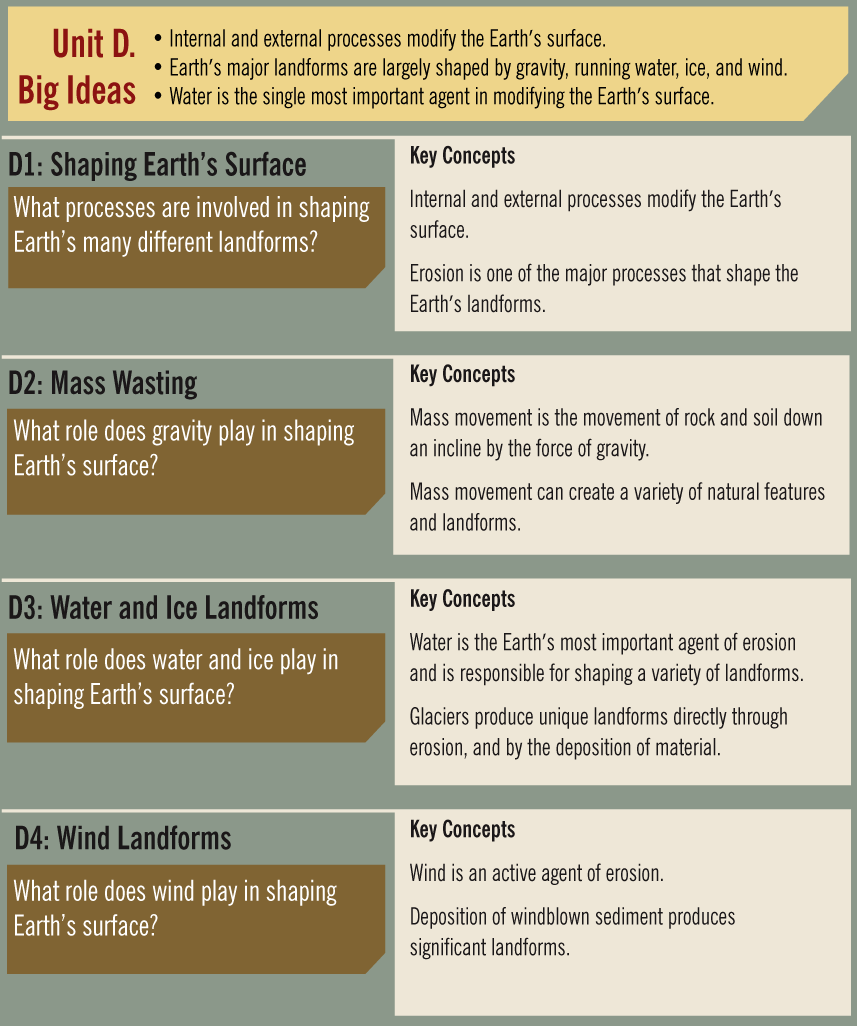
- Unit Overview and Big Ideas
- What Do You Already Know?
- Literacy Link: Living Through the Dust Bowl
- Unit Lessons
- D1: Shaping Earth’s Surface
-
- Guiding Question: What processes are involved in shaping Earth's many different landforms?
-
- Key Concepts
- Internal and external processes modify the Earth’s surface.
- Erosion is one of the major processes that shape the Earth’s landforms.
-
- D2: Mass Movement
-
- Guiding Question: What role does gravity play in shaping Earth's surface?
-
- Key Concepts
- Mass movement is the movement of rock and soil down an incline by the force of gravity.
- Mass movement can create a variety of natural features and landforms.
-
- D3: Water and Ice Landforms
-
- Guiding Question: What role does water and moving ice play in shaping Earth's surface?
-
- Key Concepts
- Water is the Earth’s most important agent of erosion and is responsible for shaping a variety of landforms.
- Glaciers produce unique landforms directly through erosion, and by the deposition of material.
-
- D4: Wind Landforms
-
- Guiding Question: What role does wind play in shaping Earth's surface?
-
- Key Concepts
- Wind is an active agent of erosion.
- Deposition of windblown sediment produces significant landforms.
-
- Wrap Up
- What Do You Know Now?

 Unit Activity
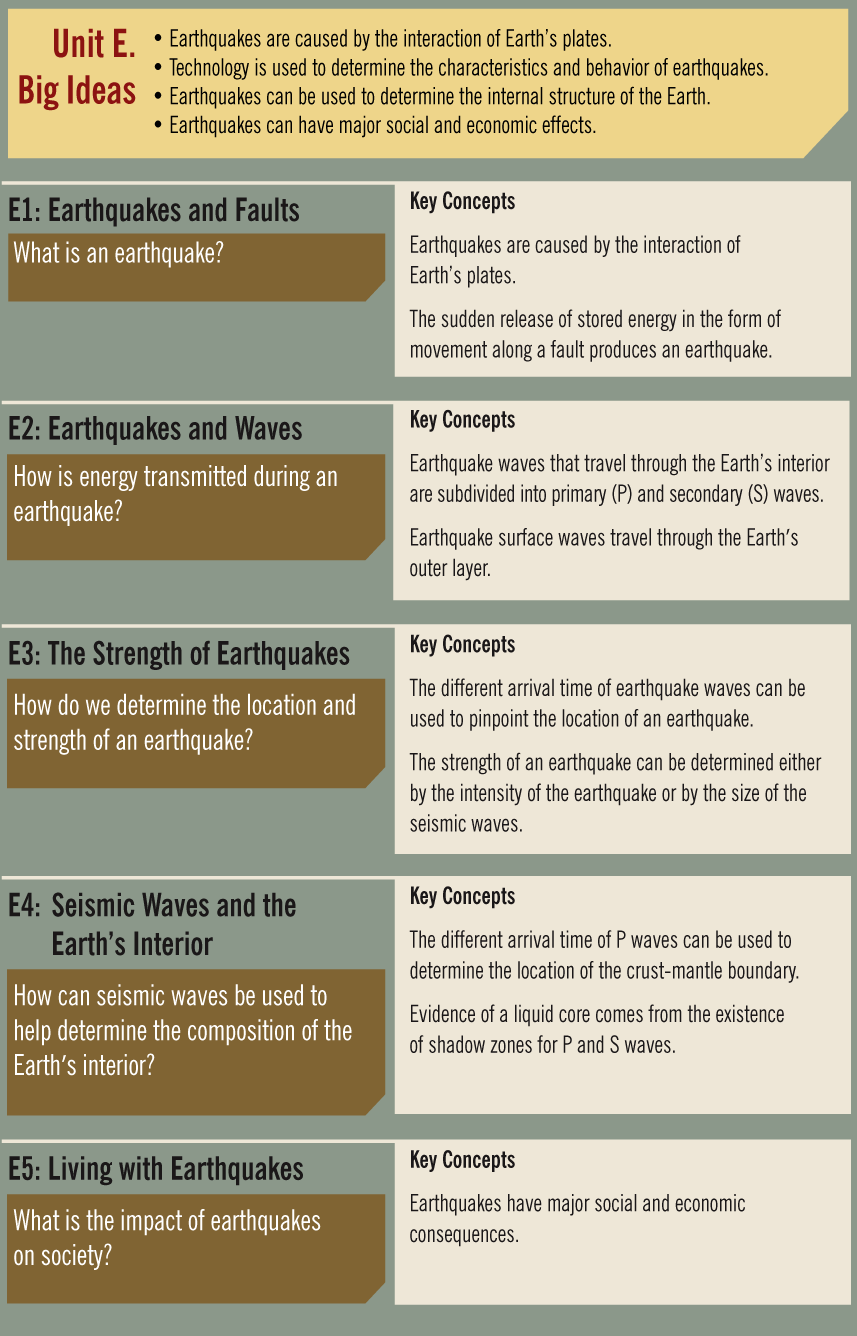
- Unit E: Earthquakes
- Get Ready
- Unit Overview and Big Ideas
- What Do You Already Know?
- Literacy Link: Mark Twain's First Earthquake
- Unit Lessons
- E1: Earthquakes and Faults
-
- Guiding Question: What is an earthquake?
-
- Key Concepts
- Earthquakes are caused by the interaction of Earth's plates.
- The sudden release of stored energy, in the form of movement along a fault, produces an earthquake.
-
- E2: Earthquakes and Waves
-
- Guiding Question: How is energy transmitted during an earthquake?
-
- Key Concepts
- Earthquake waves that travel through the Earth's interior are subdivided into primary (P) and secondary (S) waves.
- Earthquake surface waves travel through the Earth’s outer layer.
-
- E3: The Strength of Earthquakes
-
- Guiding Question: How do we determine the location and strength of an earthquake?
-
- Key Concepts
- The different arrival time of earthquake waves can be used to pinpoint the location of an earthquake.
- The strength of an earthquake can be determined either by the intensity of the earthquake or by the size of the seismic waves.
-
- E4: Seismic Waves and the Earth's Interior
-
- Guiding Question: How can seismic waves be used to help determine the composition of the Earth’s interior?
-
- Key Concepts
- The different arrival time of P waves can be used to determine the location of the crust-mantle boundary.
- Evidence of a liquid core comes from the existence of shadow zones for P and S waves.
-
- E5: Living with Earthquakes
-
- Guiding Question: What is the impact of earthquakes on society?
-
- Key Concept
- Earthquakes have major social and economic consequences.
-
- E5-1: Factors Affecting Earthquake Damage
- E5-2: Related Causes of Damage - Liquefaction
- E5-3: Related Causes of Damage - Landslides
- E5-4: Related Causes of Damage - Tsunamis
- E5-5: Related Causes of Damage - Fires
- E5-6: Living in Earthquake Country
- E5-7: Predicting Earthquakes
- Lesson Summary
- Review Questions
-
- Wrap Up
- What Do You Know Now?

 Unit Activity
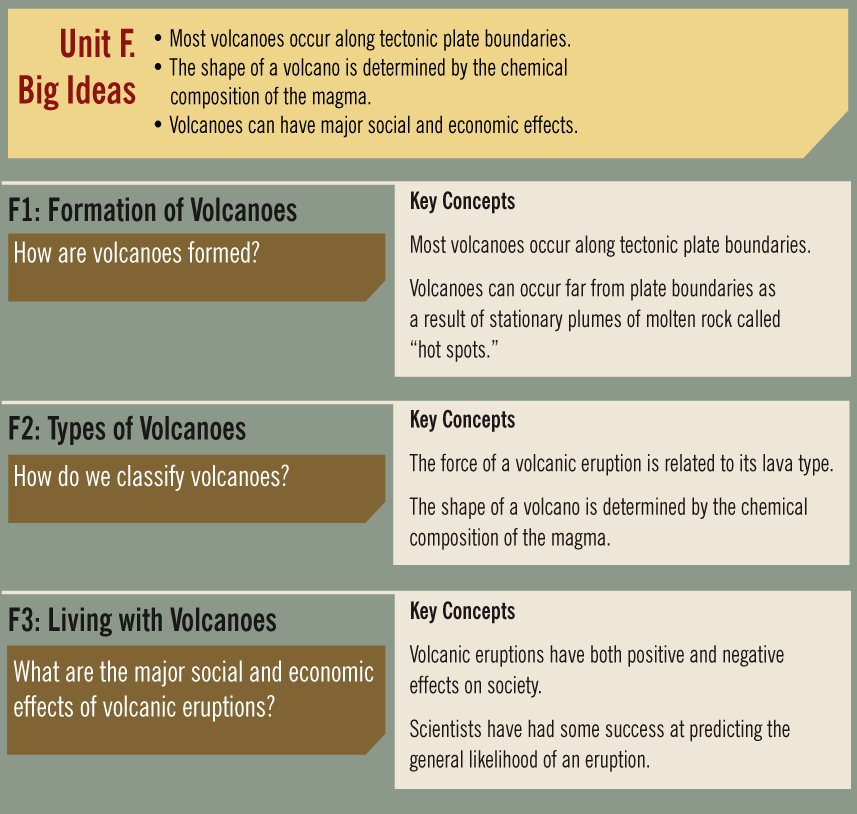
- Unit F: Volcanoes
- Get Ready
- Unit Overview and Big Ideas
- What Do You Already Know?
- Literacy Link: A Journey to the Center of the Earth
- Unit Lessons
- F1: Formation of Volcanoes
-
- Guiding Question: How are volcanoes formed?
-
- Key Concepts
- Most volcanoes occur along tectonic plate boundaries.
- Volcanoes can occur far from plate boundaries as a result of stationary plumes of molten rock called "hot spots."
-
- F2: Types of Volcanoes
-
- Guiding Question: How do we classify volcanoes?
-
- Key Concepts
- The force of a volcanic eruption is related to its lava type.
- The shape of a volcano is determined by the chemical composition of the magma.
-
- F3: Living with Volcanoes
-
- Guiding Question: What are the major social and economic effects of volcanic eruptions?
-
- Key Concepts
- Volcanic eruptions have both positive and negative effects on society.
- Scientists have had some success at predicting the general likelihood of an eruption.
-
- Wrap Up
- What Do You Know Now?

 Unit Activity
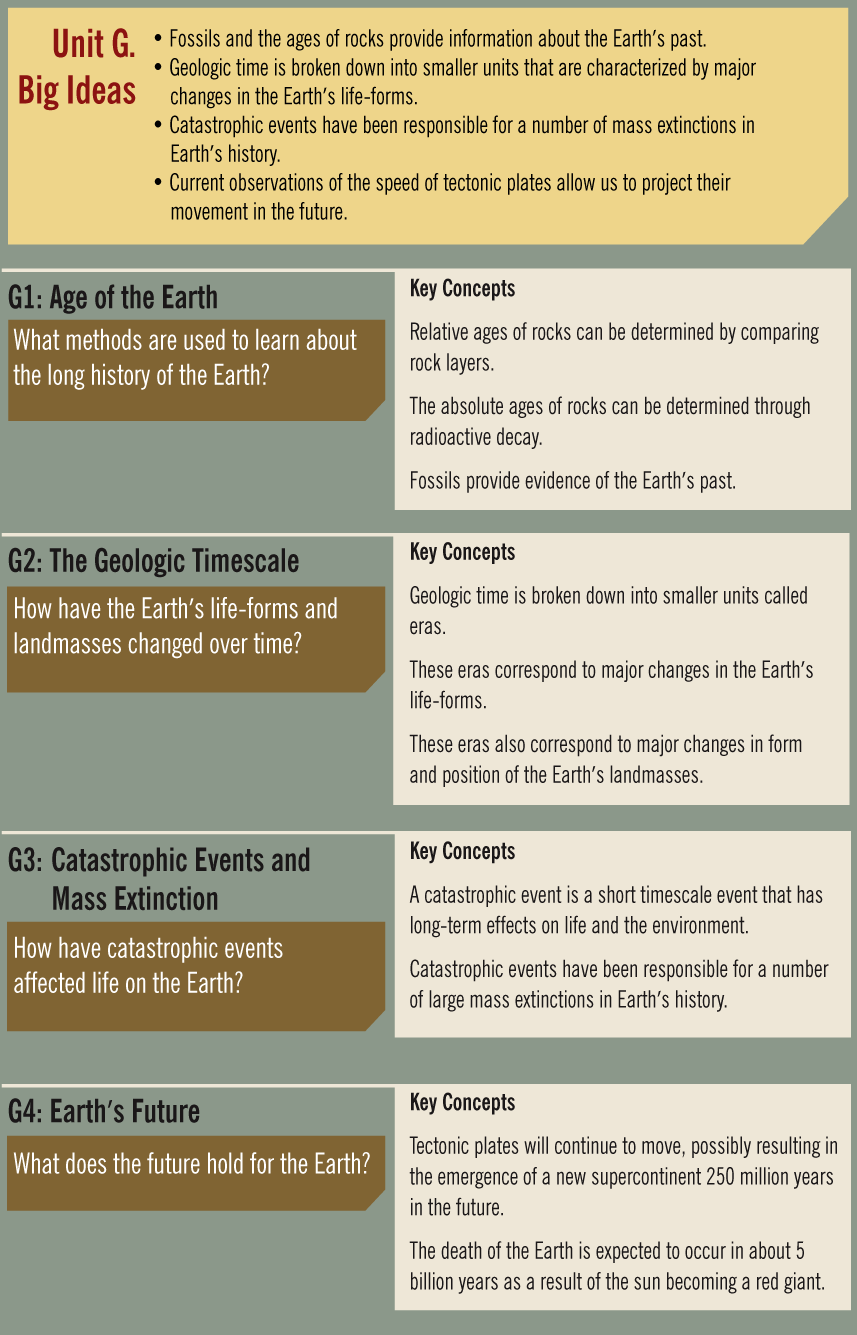
- Unit G: Geologic Time
- Get Ready
- Unit Overview and Big Ideas
- What Do You Already Know?
- Literacy Link: There Was a Second Sun
- Unit Lessons
- G1: Age of the Earth
-
- Guiding Question: What methods are used to learn about the long history of the Earth?
-
- Key Concepts
- Relative ages of rocks can be determined by comparing rock layers.
- The absolute ages of rocks can be determined through radioactive decay.
- Fossils provide evidence of the Earth’s past.
-
- G1-1: Age of the Earth
- G1-2: Relative Age
- G1-3: Unconformities
- G1-4: Cross-Cutting Relationships
- G1-5: Inclusions
- G1-6: Correlation
- G1-7: Absolute Age: Radioactive Decay
- G1-8: Absolute Age: Radiometric Dating
- G1-9: Radiocarbon Dating
- G1-10: Fossils
- G1-11: Index Fossils
- Lesson Summary
- Review Questions
-
- G2: The Geologic Timescale
-
- Guiding Question: How have the Earth’s life-forms and landmasses changed over time?
-
- Key Concepts
- Geologic time is broken down into smaller units called eras.
- These eras correspond to major changes in the Earth’s life-forms.
- These eras also correspond to major changes in form and position of the Earth’s landmasses.
-
- G3: Catastrophic Events and Mass Extinction
-
- Guiding Question: How have catastrophic events affected life on the Earth?
-
- Key Concepts
- A catastrophic event is a short timescale event that has long-term effects on life and the environment.
- Catastrophic events have been responsible for a number of large mass extinctions in Earth’s history.
-
- G4: Earth’s Future
-
- Guiding Question: What does the future hold for the Earth?
-
- Key Concepts
- Tectonic plates will continue to move, possibly resulting in the emergence of a new supercontinent 250 million years in the future.
- The death of the Earth is expected to occur in about 5 billion years as a result of the sun becoming a red giant.
-
- Wrap Up
- What Do You Know Now?

 Unit Activity
- Glossary
- Lessons
- 2011 Japan Earthquake and Tsunami
-
- Guiding Question: What were the causes and effects of the March 11, 2011 earthquake in Japan?
-
- Key Concepts
- Earthquakes are caused by the interaction of Earth's tectonic plates.
- Earthquakes can generate a tsunami.
- Earthquakes have major social and economic consequences.
-
- 2015 Gorkha (Nepal) Earthquake
-
- Guiding Question: What were the causes and effects of the massive earthquake that occurred in Nepal on April 25, 2015?
-
- Key Concepts
- Earthquakes are caused by the interaction of Earth’s tectonic plates.
- Nepal is tectonically active because of a convergent boundary between the Indian Plate and the Eurasian Plate.
- Earthquakes have major social and economic consequences.
-
- 2016 Ecuador Earthquake
-
- Guiding Question: What were the causes and effects of the massive earthquake that occurred in Ecuador on April 16, 2016?
-
- Key Concepts
- Earthquakes are caused by the interaction of Earth’s tectonic plates.
- Ecuador is tectonically active because of a convergent boundary between the Nazca Plate and the South American Plate.
- Earthquakes have major social and economic consequences.
-
- 2018 Honduras Earthquake
-
- Guiding Question: What were the causes and effects of the earthquake that occurred in Honduras on January 9, 2018?
-
- Key Concepts
- Earthquakes are caused by the interaction of Earth’s tectonic plates.
- Honduras is tectonically active because of the four plates that form the perimeter of the Caribbean plate.
- Earthquakes have major social and economic consequences.
-
- 2018 Gulf Of Alaska Earthquake
-
- Guiding Question: What were the causes and effects of the earthquake that occurred in the Gulf of Alaska on January 23, 2018?
-
- Key Concepts
- Earthquakes are caused by the interaction of Earth’s tectonic plates.
- The Aleutian Arc is a tectonically active area.
- Earthquakes have major social and economic consequences.
-
- 2023 Turkey-Syria Earthquake
-
- Guiding Question: What were the causes and effects of the massive earthquake(s) that occurred in Turkey on February 6, 2023?
-
- Key Concepts
- Earthquakes are caused by the interaction of Earth’s tectonic plates.
- Turkey is tectonically active because of the interactions between three tectonic plates, the Anatolian Plate, the Arabian Plate, and the African Plate.
- Earthquakes have major social and economic consequences.
-