Volcanoes can also form when two plates move apart (diverge), and magma flows up between the two plates. This is what is occurring in the Mid-Atlantic Ridge as oceanic crust is being pulled apart (i.e., seafloor spreading). Much of this magma from sea floor spreading does not reach the surface and remains underwater. A rare spot where this is visible above water is in Iceland as the North American and Eurasian plates diverge.
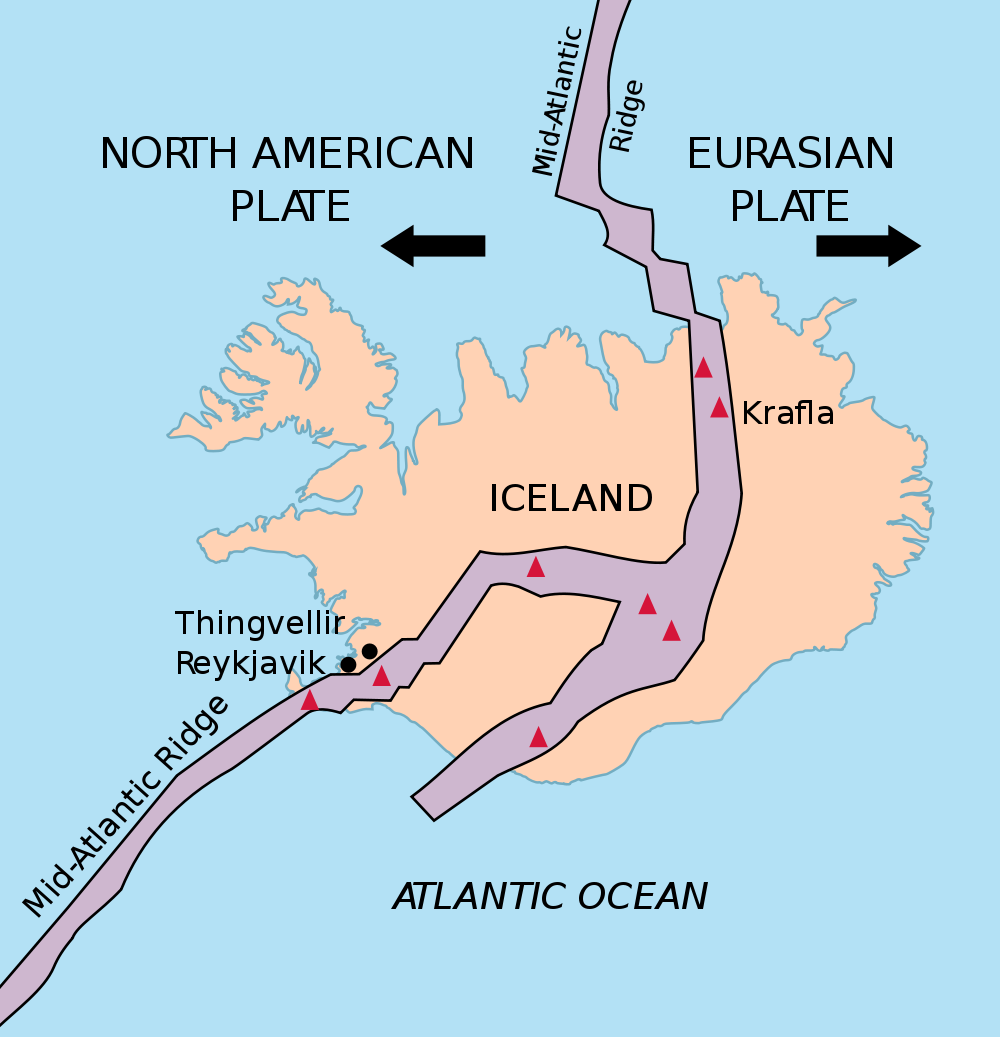 Divergent oceanic crust has resulted in a string of volcanoes forming in Iceland along the plate boundaries.
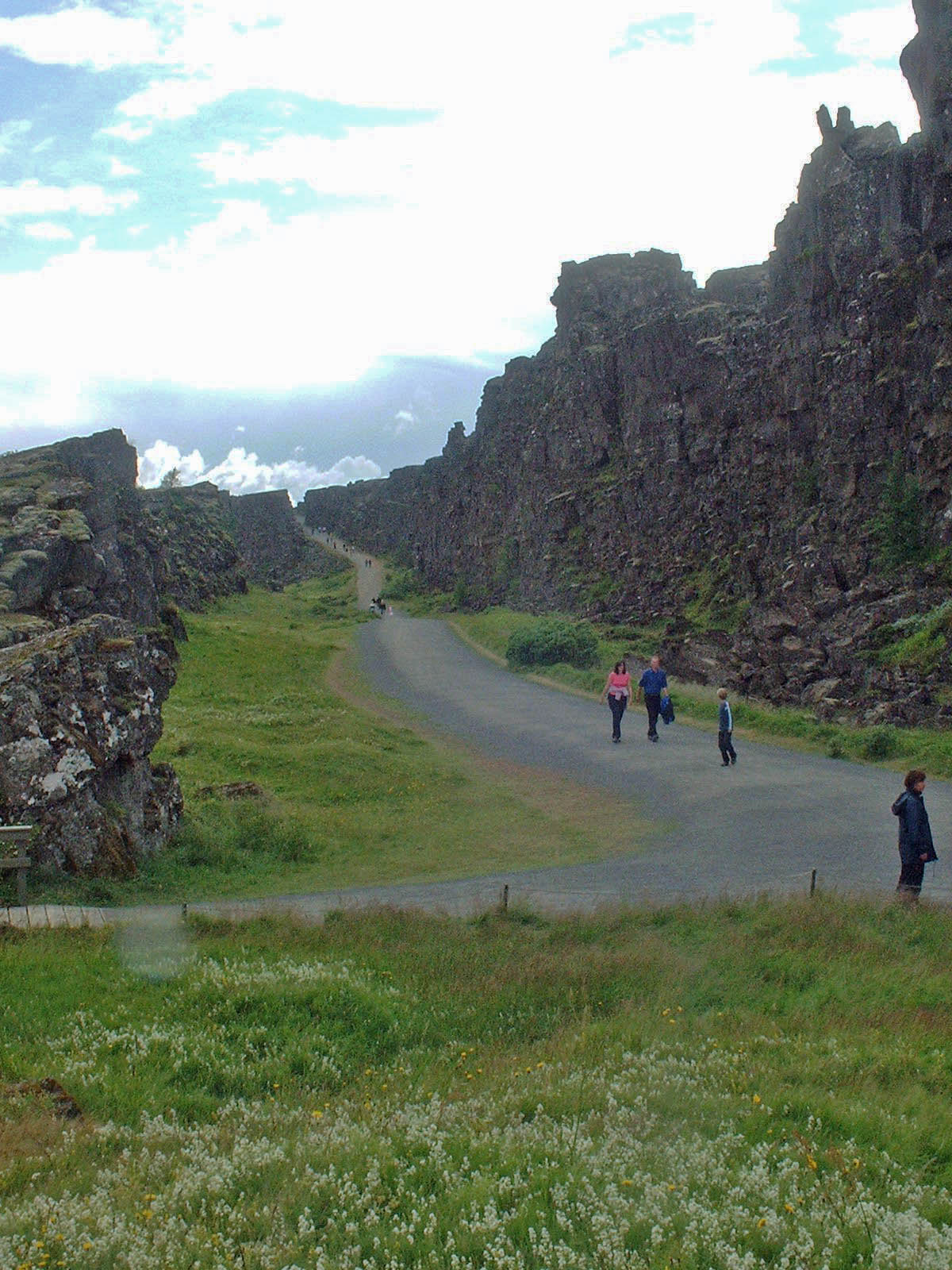 A fissure zone in Thingvellir National Park in Iceland. On the right of the fissure, the North American plate is pulling westward away from the Eurasian plate on the left-hand side of the fissure. Thingvellir National Park is a UNESCO World Heritage Site. Thingvellir was the site of meetings for the Althing, Iceland’s open air parliament between 930 CE and 1798 CE.
Although most divergent plate motion is the result of oceanic crust moving apart, this process can also be seen above ground as continental crust is pulled apart. This is exactly what is happening in East Africa in the Great Rift Valley as two parts of the African plate are pulled apart. A string of volcanoes has formed in the valley produced by this divergent plate motion.
 Try This!
Divergent Boundaries
Volcanoes frequently form at divergent plate boundaries.
- Click here to view the Great Rift Valley along with country borders.
- Zoom in on the individual countries in the Great Rift Valley in order to see their names.
- List three of the larger countries through which the Great Rift Valley runs.
Larger countries in the Great Rift Valley include Ethiopia, Kenya, Tanzania, Uganda, Democratic Republic of the Congo and Mozambique. Your list should include three of these names.
At the beginning of this section you learned that divergent plates (i.e. the Eurasian and North American plates) in the Atlantic Ocean were responsible for the formation of volcanoes on Iceland.
- Rotate the globe and determine what other oceans possess divergent plates.
- List two oceans, other than the Atlantic, that possesses divergent plates. Give two examples listing the names of the diverging plates for each of your ocean selections.
Possible examples could include:
Indian Ocean (African and Eurasian plates, African and Australian plates, African and Antarctic plates)
Pacific OCean (Pacific and Nazca plates, Pacific and Cocos plates, Pacific and Juan de Fuca plates, Pacific and Antarctic plates)