G1
Review Questions
- What basic principle underlies all of geology? What does this principle state? The principle of uniformitarianism underlies all of geology. This principle states that geologic processes at work on the Earth today were also at work long ago.
- Distinguish between relative age and absolute age. Relative age only tells us the chronological sequence within which a set of events occurred. Absolute age tells us the actual year when those events occurred.
- The diagram to the right shows a fault in a sequence of rocks. Which is older, the rock sequence or the fault? Explain. The rock sequence is older. The rocks can only have been displaced after they were formed, therefore, the fault that caused the rock movement occurred after the rock sequence was laid down.
- The ratio of parent to daughter of a radioactive element in a certain sample is 4 to 1. This same radioactive element in another rock sample shows a parent to daughter ratio of 3 to 2. Which rock sample is older and why? The second rock sample with a parent to daughter ratio of 3 to 2 is the older sample. The daughter element is formed as a result of radioactive decay. This means that the sample with the greater relative amount of daughter element has been undergoing radioactive decay for a longer period of time and is thus older.
- Why are fossils important? Fossils are important for two major reasons. They give us important information about past environmental conditions. They can also be used to correlate the ages of rocks from widely different locations.
- What four conditions must an organism meet in order for it to be considered an index fossil?
- be distributed over a wide geographical area
- be clearly recognizable with distinguishable characteristics
- be abundant
- have lived for a short span of geologic time
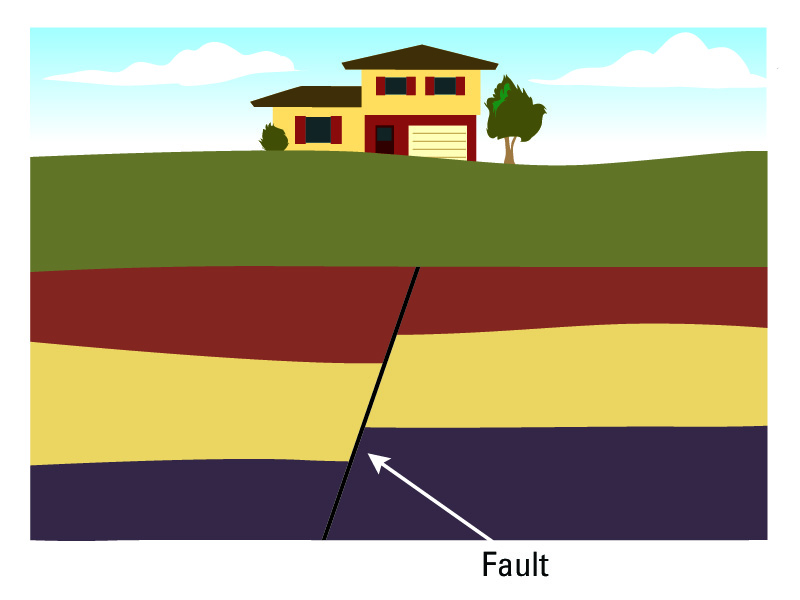 A fault in a sequence of rocks.
Species that form index fossils must: