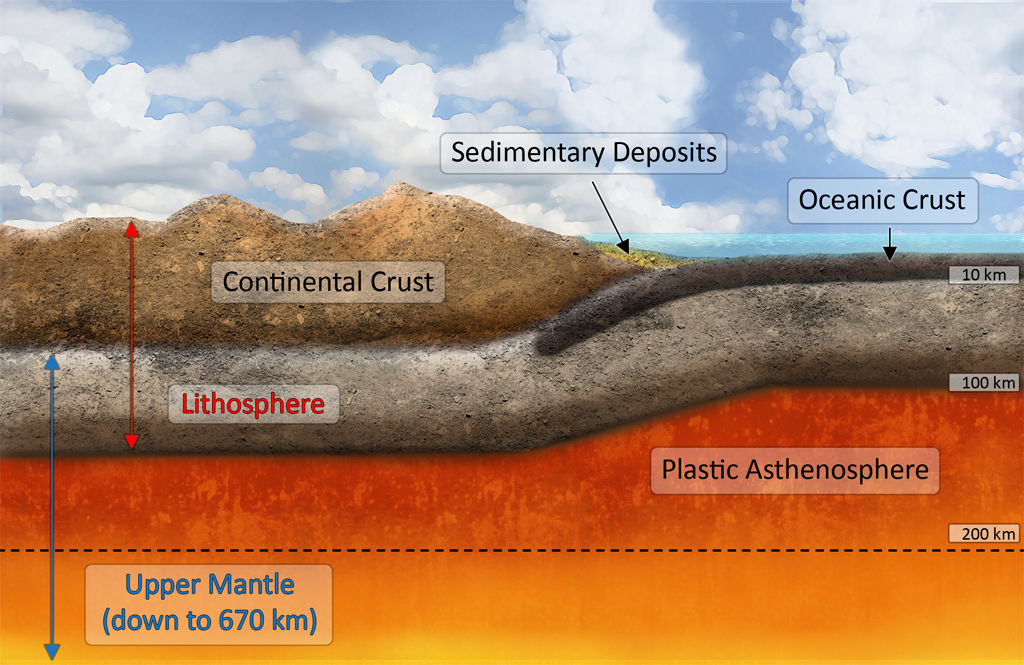
 The relationship between the crust, the lithosphere, and the asthenosphere.
 Word Link
The theory of plate tectonics states that the upper surface of the Earth is broken up into a number of large chunks of rigid material, or plates, that are constantly in motion (see diagram to far right). These plates are composed of oceanic and/or continental crust, and the rigid upper part of the mantle. These two sections together make up the lithosphere which extends to a depth of approximately 100 kilometers (approximately 60 miles). These plates ride on top of the asthenosphere, a layer of flowing rock in the mantle. These plates, containing the oceans and the continents, act very much like large rafts floating on a liquid.
Scientists have identified 7 large plates:
- North American Plate
- South American Plate
- Pacific Plate
- African Plate
- Eurasian Plate
- Australian-Indian Plate
- Antarctic Plate
A host of smaller plates have also been identified, the seven largest of which are:
- Caribbean Plate
- Arabian Plate
- Juan de Fuca Plate
- Cocos Plate
- Nazca Plate
- Philippine Sea Plate
- Scotia Plate
Did You Know?
The Origin of “Plates”
In 1965, J. Tuzo Wilson (1908–1993), a geophysics professor at the University of Toronto, was the first person to use the term plates to describe the rigid bodies of the lithosphere that were slowly moving over the Earth’s surface.The theory of plate tectonics has become the dominant theory in Earth science because its unifying nature provides an explanation for a large number of physical processes including earthquakes, volcanoes, and mountain formation. The modern theory of plate tectonics is basically a combination of the continental drift theory, and the seafloor spreading theory.
Try This
Pangaea and the African Plate
When the original supercontinent Pangaea broke up into plates, ocean crust formed between the plates as they slowly moved apart. We can, therefore, use the age of the seafloor off a continental shelf to help us determine when a particular part of a plate broke off from Pangaea.
- Click here to see the African plate and the age of the seafloor off west Africa.
- What is the age of the seafloor off the continental shelf at Senegal’s capital Dakar? The seafloor off Dakar, Senegal is 180 million years old.
- How long ago did the current region of Dakar, Senegal break off from Pangaea? Dakar broke off from Pangaea 180 million years ago.
- What is the age of the seafloor off the continental shelf at Liberia’s capital Monrovia? The seafloor off Monrovia, Liberia is approximately 100 million years old.
- How long ago did the current region of Monrovia, Liberia break off from Pangaea? Monrovia broke off from Pangaea approximately 100 million years ago.
- How can we account for the fact that Dakar and Monrovia broke away from Pangaea at different times even though they are on the same tectonic plate? This means that Pangaea did not break up uniformly all at the same time. The breakup of the African plate from Pangaea took place over an extended period of time with the Monrovia section breaking away much earlier than the Dakar section.