Analyzing Lava Flows
Objective: To analyze the location of past lava flows in Yellowstone National Park and then calculate the direction and speed of the North American plate as it slides above the hot spot.
Materials Required: Everything that you need for this exercise is included in the on-screen components.
Time Required: 2 hours
You are a geologist working for the Rock On Analytics Corporation. Your company has recently been awarded a contract from Yellowstone National Park, one of the premier national parks in the United States. The park has volcanic origins and many extensive lava flows are evident. You have been asked to analyze the locations and extent of these past lava flows, and to determine the current motion of the park over the source of these lava flows.
Part A: Direction and Speed of the North American Plate
Geologists have mapped several large lava fields that formed as a result of large volcanic eruptions in what is today Yellowstone National Park. Scientists have also noted that there are a series of lava fields outside of Yellowstone that get progressively older the farther away you get from the park. Scientists have used this evidence to conclude that these lava fields were formed by a hot spot whose location is currently under Yellowstone National Park.
Your task is to examine the location of these lava fields and to calculate the direction and speed of the North American plate as it slides above the hot spot.
Use the map and data on the Main View to assist you in this task. You will have to measure distances using the measuring tool.
Helpful Hint: You should probably not use the lava field dated at 2 million years since this is older than the next one further out (i.e., 1.3 million years); geologists speculate that this may have been due to a bifurcation in the hot spot magma chamber as it emerged on the surface—using this lava field will probably throw off the calculations slightly. Use the approximate center point of each lava field to measure the distance traveled between each lava field.
Here is a table where you can record your information and results.
Age of Lava Field as Indicated on Map (years) | Age of Lava Field Used for Calculation (years) Hint: use the middle of the age range in the first column. |
Travel Time From Previous Lava Field (years) |
Distance Traveled (kilometers) |
Average Speed 1 km = 100,000 cm |
| 1.3 × 10⁶ | ||||
| 6.5–4.3 × 10⁶ | ||||
| 10–7 × 10⁶ | ||||
| 10.5–8.6 × 10⁶ | ||||
| 12–10.5 × 10⁶ | ||||
| 15–13 × 106 | ||||
| 16.5–15 × 106 |
You should compare your calculation with those done by other scientists; their work shows a current speed for the North American plate of 2.5 cm (about 1 inch) per year.
Part B: Using Ash Deposits to Estimate Size of Eruption
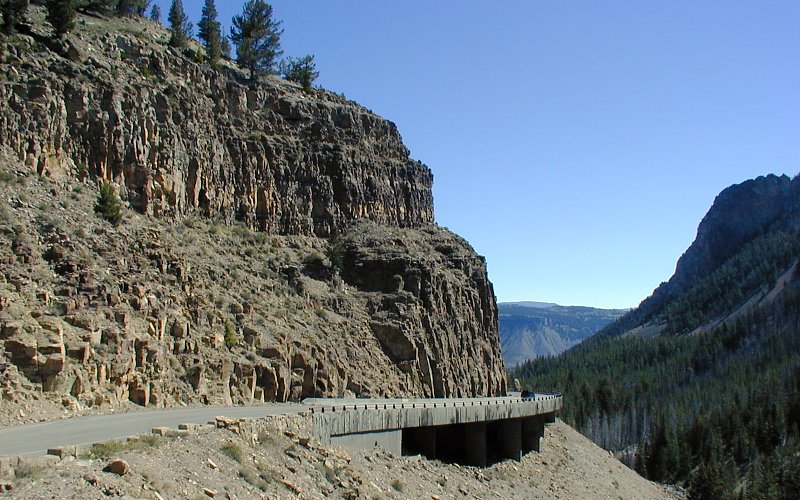 Part of the Huckleberry Ridge ash and lava layer that was formed as a result of a volcanic explosion at Yellowstone National Park 2.1 million years age.
Several of the volcanic eruptions that you tracked in Part A also left huge ash deposits over much of the continental United States. Careful geologic work has provided fairly accurate maps of these ash deposits. You have been asked to determine the surface area (in square kilometers) that each of these ash deposits cover, and then to relate each of these as a percentage in comparison to the overall surface area (8.08 × 10⁶ km2 ) of the continental United States. This information will then be used to try to give the general public an idea of exactly how big these explosions actually were. The United States Geologic Survey (USGS) has provided the data that will assist you in doing your calculations. You will need to use the polygon measuring tool since you will have to do area measurements on each ash deposit.
After attempting to do the activity on your own, you can review the answers by clicking on the View Answers button.
Unit Activity Answers
Part A: Direction and Speed of the North American Plate
You will have to make some assumptions about how to do this part of the assignment. Distance traveled by the hot spot can be done a number of ways, but probably the easiest and most accurate is to measure the distance between successive lava fields. You will have to estimate the approximate center of each lava field. You will have to pick an origin for your first measurement. Select the center of the most recent lava field that defines the current Yellowstone caldera (i.e., the one labeled 630,000 years). Making these assumptions yields the following data:
Age of Lava Field as Indicated on Map (years) | Age of Lava Field Used for Calculation (years) Hint: use the middle of the age range in the first column. |
Travel Time From Previous Lava Field (years) |
Distance Traveled (kilometers) |
Average Speed 1 km = 100,000 cm |
| 1.3 × 10⁶ | 1.3 × 10⁶ | 1.3 × 10⁶ | 27 | 1.8 |
| 6.5–4.3 × 10⁶ | 5.4 × 10⁶ | 4.1 × 10⁶ | 40 | 1.6 |
| 10–7 × 10⁶ | 8.5 × 10⁶ | 3.1 × 10⁶ | 49 | 2.5 |
| 10.5–8.6 × 10⁶ | 9.6 × 10⁶ | 1.1 × 10⁶ | 69 | 10 |
| 12–10.5 × 10⁶ | 11.3 × 10⁶ | 1.7 × 10⁶ | 61 | 5.8 |
| 15–13 × 106 | 14 × 106 | 2.7 × 10⁶ | 61 | 3.6 |
| 16.5–15 × 106 | 15.8 × 10⁶ | 1.8 × 10⁶ | 24 | 2.2 |
The average of all our average speeds needs to be calculated. Add all the values in the last column of the table: 1.8 + 1.6 + 2.5 + 10 + 5.8 + 3.6 + 2.2 = 27.5
To find the average, divide 27.5 by the number of values added and round to the nearest tenth: 27.5 ÷ 7 = 3.9 cm/year. Any answer of centimeters per year in the low or mid-single digits is a reasonable answer for Part A.
Now that you know the speed, you must not forget to answer what direction the North American plate is traveling. According to the map, the overall direction of the North American plate is southwest.
Part B: Using Ash Deposits to Estimate Size of Eruption
As suggested by the Helpful Hint, you should use the polygon measuring tool to draw a geometric figure on top of each ash deposit to approximate the area in square kilometers of each ash fall. You can find the area of of your geometric figure by pointing your cursor at any of the points of the geometric figure and reading the area measurement value given. (Your calculations will vary depending on exactly how you draw these geometric figures.) You will then need to compare these areas to the surface area of the continental United States (8.08 × 10⁶ km2).
Lava Creek ash bed: This area is about 4.08 x 10⁶ km2. Using the area of the continental U.S. as 8.08 × 10⁶ km2, then the area of the Lava Creek ash bed is approximately equal to 50.4% of the area of the continental United States.
Huckleberry Ridge ash bed: This area is about 2.97 x 10⁶ km2. Using the area of the continental U.S. as 8.08 × 10⁶ km2, then the area of the Huckleberry Ridge ash bed is approximately equal to 36.8% of the area of the continental United States.
Mesa Falls ash bed: This area is about 9.50 x 10⁵ km2. Using the area of the continental U.S. as 8.08 – 106 km2, then the area of the Mesa Falls ash bed is approximately equal to 11.8% of the area of the continental United States.