 Did You Know?
The interior of the Earth represents a huge reservoir of heat. Just 80–100 km (approximately 50–60 miles) beneath the Earth’s surface, the temperature is estimated to range between 650–1,200° C (1,200–2,200° F). We can see small amounts of this heat escaping to the Earth’s surface whenever a volcano erupts. What is the ultimate source of this heat in the interior of the Earth? Scientists theorize that the Earth’s internal heat comes from two main sources: residual heat and radioactive decay.
- Residual Heat: Residual heat refers to the heat trapped inside the Earth when it was originally formed approximately 4.6 billion years ago that is slowly escaping from the Earth. It is taking a long time for this heat to dissipate since the Earth’s crust effectively acts like a giant insulating blanket. The heat given off by a burner plate on your stove as it slowly cools is an example of residual heat on an everyday, small scale. Residual heat, however, contributes a minor role to the overall source of internal heat of in the Earth.
- Radioactive Decay: Radioactive decay is the process whereby unstable atoms in an element break apart and form new elements. Energy is released as a part of this process. This spontaneous breakdown of elements can occur in a matter of days (i.e., iodine 131), or it can take thousands of years (i.e., carbon 14). Some elements can even take billions of years to slowly decay into other elements. It is just these kinds of elements such as potassium 40, uranium 238, and thorium 232 that are responsible for heating the interior of the Earth through their slow radioactive decay. It is believed that radioactive decay is the major source of heat for the Earth’s interior.
 Residual heat escaping from the engine and hood of a parked van.
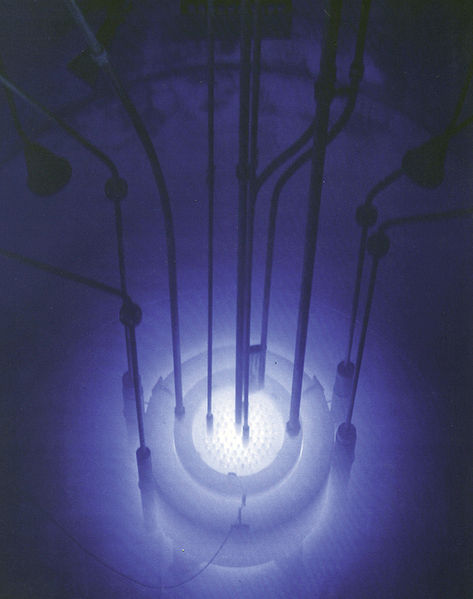 The glow of light about this reactor represents energy given off as a result of radioactive decay.
Math Link
The glow of light about this reactor represents energy given off as a result of radioactive decay.
Math Link
Calculate the half-life of thorium to determine if Earth will run out of this internal heat source any time soon. Go to Math Link...
Try This!
Surface Radiation
Uranium can be found embedded in surface rocks and soils. Under normal conditions these uranium surface concentrations are small and don't normally pose an elevated risk to humans.
- Click here to view a map of the surface concentration of uranium in the continental U.S.
- Examine the scale carefully.
- Which color corresponds to high surface concentrations of Uranium? What is this concentration? The color red corresponds to high surface concentrations of Uranium. This concentration is 5 ppm (parts per million).
- Which color corresponds to low surface concentrations of Uranium? What is this concentration? The color deep blue corresponds to low surface concentrations of Uranium. This concentration is 0 ppm.
- Which part of the U.S. shows high concentrations of surface Uranium? The southwest shows high concentrations of surface uranium.
- Click here to add in state boundaries.
- Zoom in on the grouping of states that exhibit high surface concentrations of Uranium.
(Click here if you need help with this.)
- Name these states with high surface concentrations of Uranium. The grouping of states with a high surface concentration of Uranium consists of California, Nevada, Utah and Arizona.
- Can you think of a reason why this area exhibits such high levels of surface Uranium? Although this area does possess some natural surface concentrations of Uranium, much of the Uranium surface concentration comes from contaminated tailings and surface soil from the many abandoned mines (estimated to be in the hundreds) that dot the area.