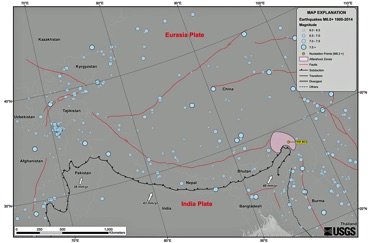
 A map showing fault lines and major earthquake locations in the Nepal area.
The Nepal area is no stranger to earthquakes as the main view panel shows. Historically, earthquakes have occurred on a fairly regular basis in Nepal.
 Try This!
Plate Tectonics and Nepal
The large April 25 earthquake in Nepal was itself accompanied by numerous smaller earthquakes and one fairly large aftershock of magnitude 7.3 that occurred on May 12, 2015.
- Click here to see the location of all of these earthquakes.
This seismic activity is the result of the ongoing collision between two large crustal plates.
- Click here to see tectonic plate boundary outlines in the Nepal area.
- What mountain chain is located right at the plate boundary outline? The Himalayas are located right at the plate boundary outline.
- Click here to shade in the tectonic plates so that they are more visible.
- What two plates are colliding in the Nepal area? The Indian Plate and the Eurasian Plate are colliding in the Nepal area.
- What kind of interaction is occurring between these two plates? Explain your reasoning. The Indian Plate is colliding into the Eurasian Plate. The location of the Himalayas just north of the boundary between the Indian and Eurasian plates provides evidence of this. The Himalayas were formed as a result of the Indian Plate being subducted beneath the Eurasian Plate.
- Click here to see a tectonic plate velocity map.
- How fast are the Indian and Eurasian tectonic plates moving? The Indian Plate is moving at approximately 50 mm/yr (2.0 in/yr) while the Eurasian Plate is moving at approximately 20 mm/yr (0.79 in/yr).
- Click here to add in direction vectors for the plate movement.
- Which direction is each plate moving at Nepal-Himalayan Mountains interface? The Indian Plate is moving in a northeast direction while the Eurasian Plate is moving in an easterly direction at the Nepal-Himalayan Mountains interface.
- Does the information about plate velocity and direction support your answer to question 3? Explain. Yes, the information about plate velocity and direction supports the view that the Indian Plate is colliding with the Eurasian Plate. The Indian Plate is travelling faster than the Eurasian Plate. The result is that the Indian Plate is being subducted under the Eurasian Plate. The Himalayas were formed as a result of the crumpling of the Eurasian Plate at this interface.
- What kind of plate boundary interface exists between the Indian and the Eurasian plates? The interface between the Indian and Eurasian plates represents a convergent plate boundary.
- Click here to see the boundary interface between the Indian and Eurasian plates.
- Click here to see the strain map at this point.
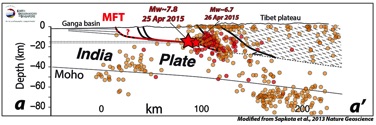 The Gorkha Earthquake was located in the subduction zone of the Indian Plate.
A convergent boundary exists between the Indian and the Eurasian plates. The subduction of the Indian Plate beneath the Eurasian Plate is the primary driver for the ongoing seismic activity in the area. The crumpling of the Eurasian Plate is responsible for the formation of the Himalayan Mountains.
The current interaction between the Indian and the Eurasian plates is part of a process that began approximately 150 million years ago when a land mass that would become the Indian Plate broke off from a large supercontinent called Gondwanaland.
- Click here to view an animation tracking the formation of the Indian Plate and its eventual collision with the Eurasian Plate. The animation starts with the continent configuration 150 million years ago, and ends in the present time.
Did You Know?
State of Compression
The ongoing collision between the Indian and Eurasian plates has resulted in the Indian Plate compressing at an approximate rate of 4.0 mm/yr (0.16 in/yr).