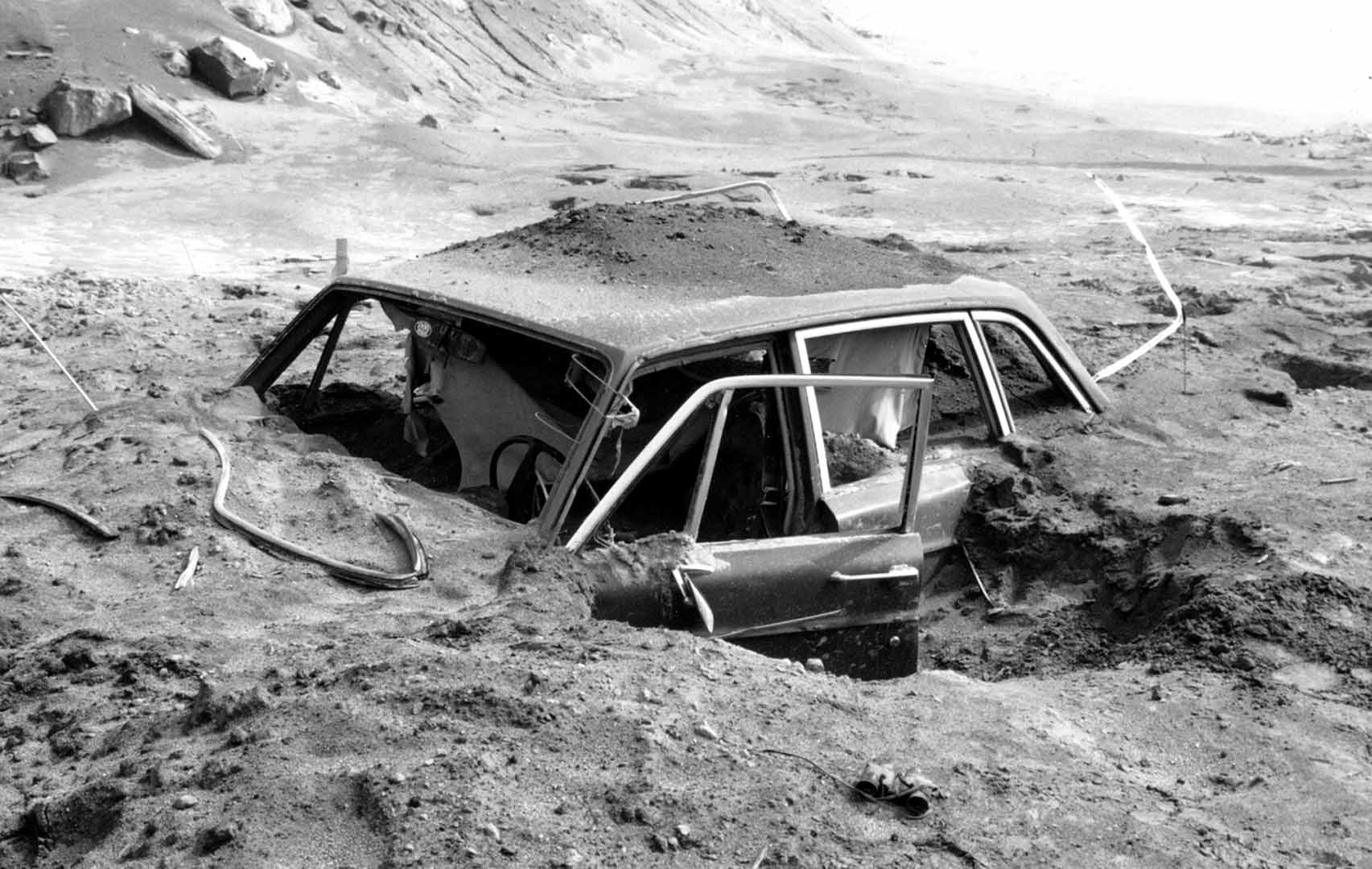
 A car buried in over a meter (3 feet) of ash from the Mt. St. Helens eruption. This car was over 10 kilometers (6 miles) away from the summit of the mountain.
Ash: Volcanic ash can be dispersed over quite a large area as a result of an eruption. The graphic to the right shows the ash distribution from the 1980 eruption of Mt. St. Helens. These ash layers can pose serious health and economic concerns. The ash can make it difficult to breathe, and can aggravate respiratory conditions like asthma and bronchitis. It can also pollute water supplies, affect crops and livestock, and damage mechanical and electrical equipment.
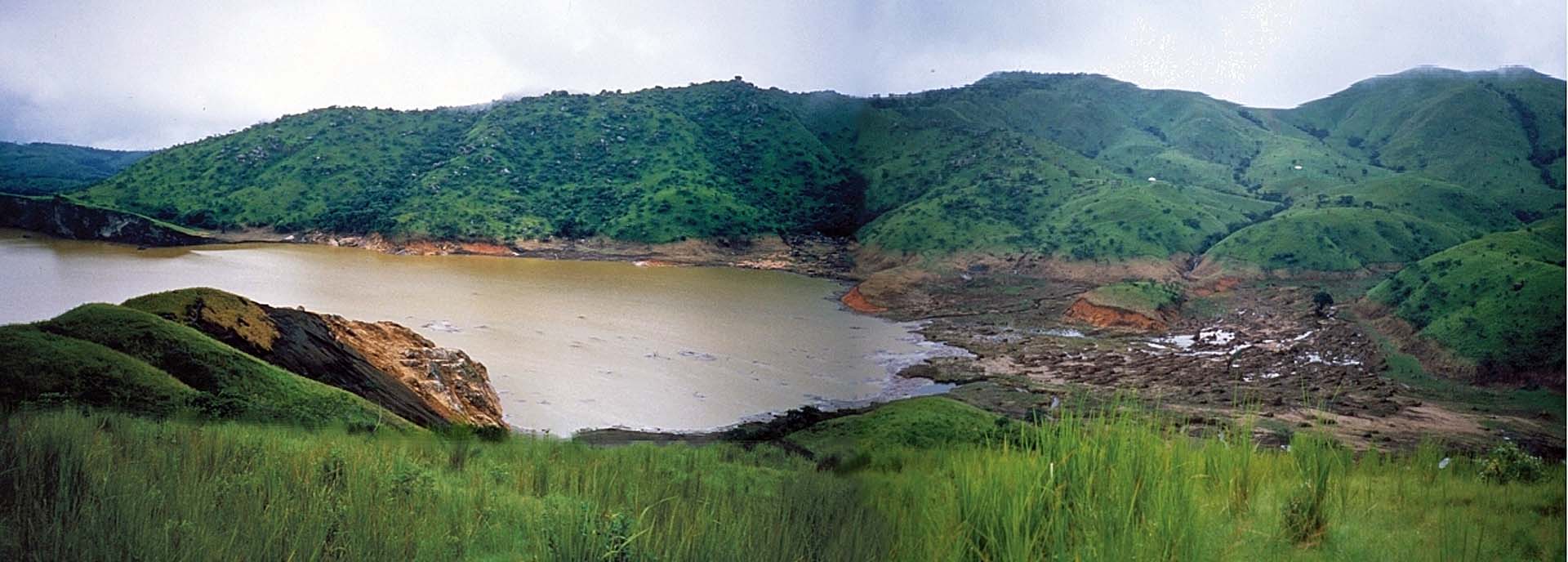 Lake Nyos in Cameroon, one week after the release of the carbon dioxide cloud. The scouring of the vegetation was caused by a water surge that accompanied the release of the toxic cloud.
Gas Emissions: Volcanoes also emit large quantities of gas that can often be quite toxic. These gases include carbon dioxide (CO2), hydrogen sulfide (H2S), and sulfur dioxide (SO2). All of these gases can result in serious health and environmental effects. Sulfur dioxide, for example, can combine with water droplets in the atmosphere and result in acid rain.
An eruption is not necessarily required in order for toxic gases to be emitted in a volcanic region. On August 21, 1986, a cloud of carbon dioxide gas erupted from Lake Nyos, a small volcanic crater lake in Cameroon. The release of carbon dioxide resulted in the deaths of over 1,200 people and approximately 3,000 cattle.
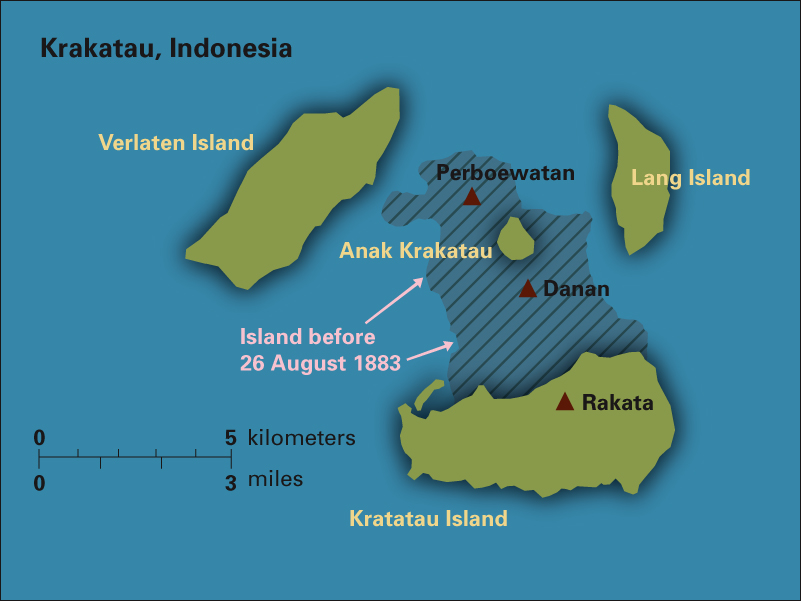 A map illustrating how much of the island of Krakatoa (Krakatau in Indonesian) disappeared as result of the 1883 eruption.
Landslides and Tsunamis: Landslides can also sometimes cause significant damage as large masses of rock, soil, ash, and other debris slide down the side of a volcano. Volcanic eruptions near water can also produce tsunamis that sometimes result in significant loss of human life. For example, the 1883 eruption of Krakatoa in Indonesia produced a tsunami that resulted in approximately 36,000 deaths. (The island of Pulau Rakata, Indonesia is part of what remains of the original island.)
 Did You Know?
Earth System Link
Did You Know?
Earth System Link
In 1784, Benjamin Franklin, made the first historically recorded connection between volcanic eruptions and global climate change.
Go to Earth System Link...
Try This!
The Year Without a Summer - 1816
Extremely large volcanic eruptions can sometimes have major influences on the entire climate of the Earth (See the Earth Systems Link in this section for more information on the connection between volcanoes and climate change.) The eruption of Mt. Tambora in Indonesia in 1815, the largest volcanic eruption in recorded history, resulted in the following year being known as the “year without a summer” with both Europe and northeastern North America experiencing snowfalls in August.
- Click here to see data describing the temperature anomalies in Europe in 1816.
- Carefully examine the temperature anomaly scale
- What range of colors highlight temperatures that were:
- below normal? Below average temperatures are indicated by a color range between light blue to very dark purplish-blue.
- above normal? Above average colors are indicated by a color range between light yellow to dark red.
- How would you describe the average temperatures in:
- Europe? The average temperatures in Europe were below normal.
- the small part of western Asia covered by our data? The average temperatures in the part of Asia covered by our data were above normal.
- Click here to add in country borders.
- Zoom in on the country that had the greatest temperature drop. (Click here if you need help in identifying this country.)
- What country experienced the greatest temperature drop, and by how much? France experienced the greatest temperature drop; a drop of up to 30 C (5.40F).
- Change your view in order to locate the one part of Scandinavia that experienced a slight increase in average temperature. (Click here if you need help in identifying this area.)
- What Scandinavian country experienced a slight increase in temperature in part of its territory, and by how much? Norway experienced a temperature increase of approximately 0.1 – 0.20C (0.2 – 0.40 F) in parts of its territory.
- Click here to add in the locations of some major European and Asian capitals.
- Zoom in on each capital in order to complete this table describing temperature anomalies in the summer of 1816.
Note: Actual answers may vary slightly because of accuracy of color matching. Answers should, however, be similar to these values.
Capital Temperature Anomaly (0C) Madrid -2.0 London -2.5 Paris -3.0 Berlin -1.5 Budapest -1.0 Rome -1.2 Istanbul +0.2 Moscow +0.8