Volcanoes often give warning signals when they are about to erupt. Although these warning signals have allowed scientists to have some success at predicting the likelihood of an eruption, it is still quite difficult to determine the exact time, scale, and intensity of an eruption. Warning signs used to indicate the likelihood of an eruption include seismic behavior, ground deformation, gas composition, and past history of eruptions.
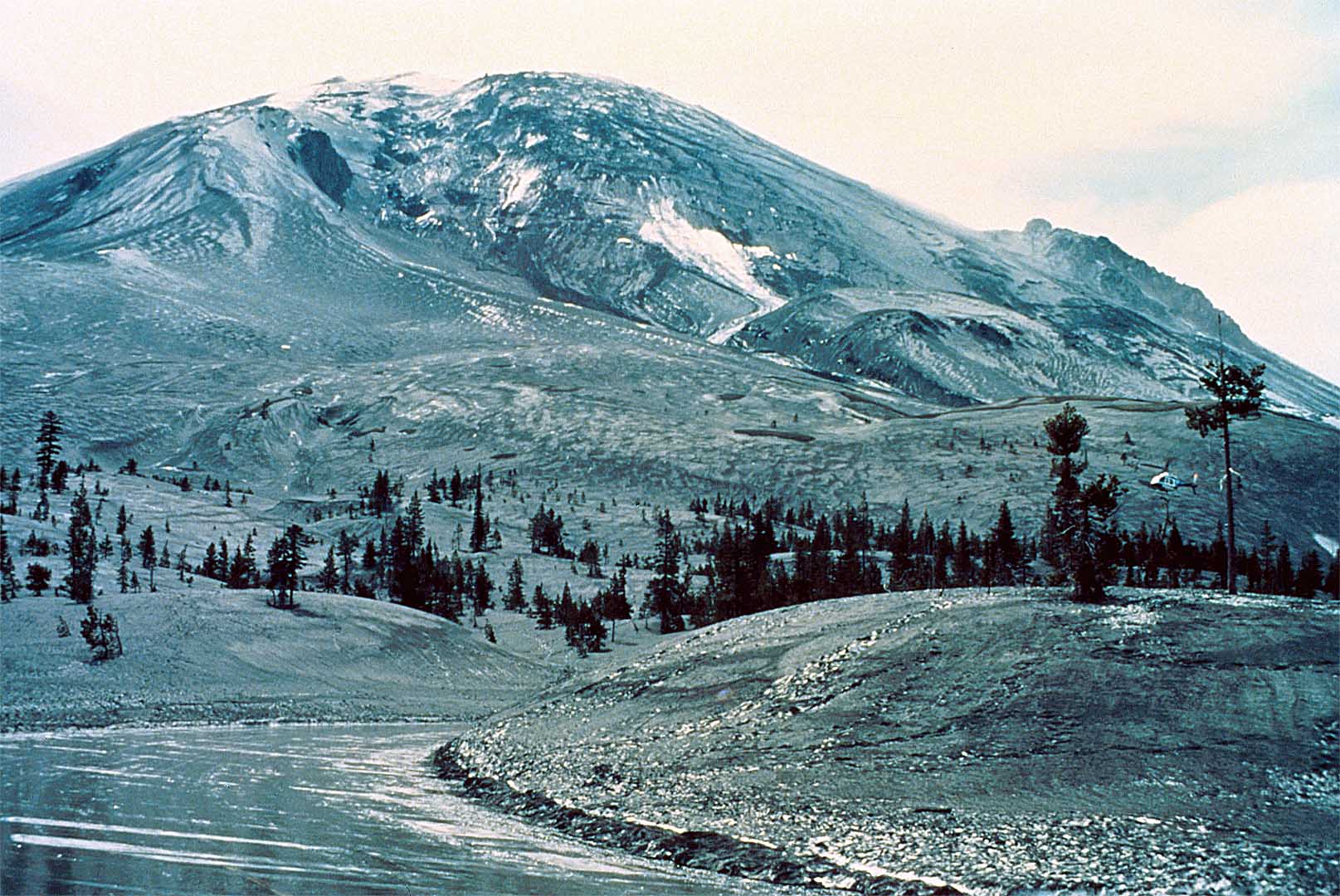 This photo shows the bulge that developed on the north side of Mt. St. Helens (center top-right side of photo). The bulge grew over 1.5 meters (5 feet) per day, and just prior to the eruption it had grown over 135 meters (443 feet) total.
Seismic Behavior: Changes in frequency, intensity, and distribution of seismic behavior such as earthquakes often signal that a volcanic event is imminent. These seismic changes are caused by the movement of magma under the Earth’s surface. Mt. St. Helens experienced a series of earthquakes prior to its eruption on May 18, 1980. Seismic monitoring of Mt. Pinatubo in the Phillipines in 1991 led scientists to believe an eruption was imminent and resulted in a successful evacuation that saved the lives of thousands of people prior to the Pinatubo’s actual eruption.
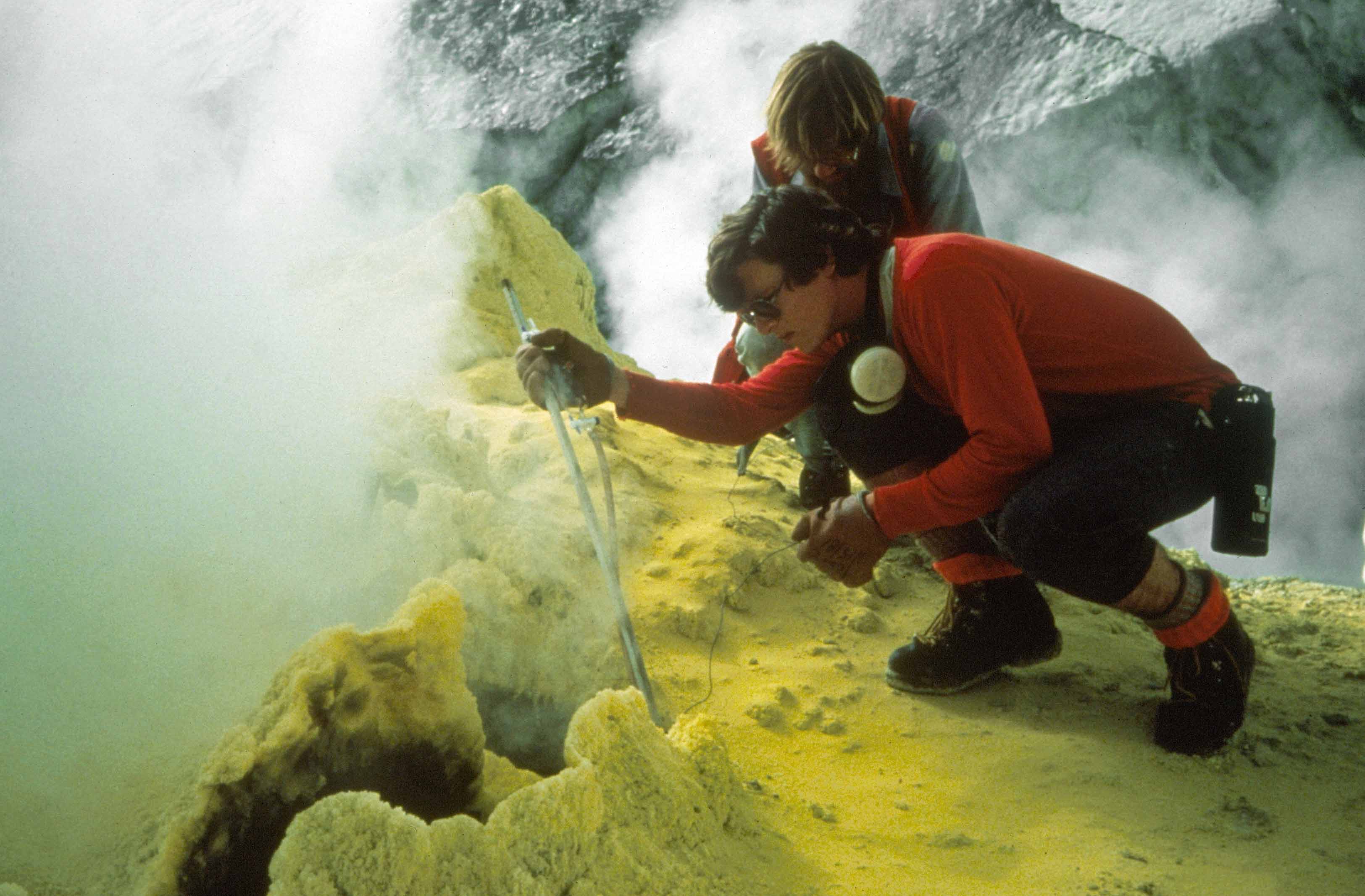 Sampling gas on Mount Baker in Washington.
Ground Deformation: The accumulation of new magma from deep within the Earth often causes a swelling or bulge in the ground on the volcano. Sometimes, as in the case of Mt. St. Helens in 1980, this bulge can become quite noticeable immediately prior to an eruption because of the incredible pressure building up in the ground.
Gas Composition: Changes in gas composition, particularly in sulfur dioxide (SO2), also act as a volcanic signal. A ten-fold increase in sulfur dioxide emissions over a period of two weeks helped scientists predict the eruption of Mt. Pinatubo in 1991. This large increase in emissions was then followed by a sharp decrease in gas levels as gas passages were sealed by hardened magma just prior to the eruption.
 Travel Link
On May 18, 1980, Mt. St. Helens experienced a catastrophic eruption. Go to Travel Link...
Past History: Knowledge of a volcano’s past history such as frequency of eruptions, extent and depth of lava flows, and severity of eruptions can also successfully contribute to predicting a volcano’s future behavior.
Learning Activity
One widely used method in predicting the future behavior of volcanoes is a detailed examination of past eruption history. The Cascade Mountain Range in the northwestern United States has been extensively investigated. An examination of this history might provide useful information in future planning.
Click here to view a map of the major volcanoes in the Cascade Range. Examine the map carefully.
- List the three states that encompass the Cascade Range.
The Cascade Range goes through the states of California, Oregon, and Washington. (Note: The Cascade Range continues in to Canada in the province of British Columbia.) - Which states possess the majority of the Cascade volcanoes?
Oregon and Washington possess the majority of the Cascade volcanoes.
Click here to see a graphic listing eruptions that have occurred in the Cascade Range during the past 4,000 years. Use this graphic to answer the following questions.
- Which volcanoes have not erupted at all in the past 4,000 years?
Mount Jefferson and Crater Lake are the only volcanoes that have not erupted at all in the last 4,000 years. - Which volcano has erupted most frequently in the past 4,000 years? How many times has this volcano erupted?
Mt. St. Helens has erupted most frequently in the last 4,000 years. It has erupted at least 22 times. - Approximately what percentage of the Cascade volcanoes have erupted in the past:
- 2,000 years 11 out of 13 have erupted, or approximately 85%
- 1,000 years 8 out of the 13 have erupted, or 9 out of 13 if we include Mount Adams (just to the left of the 1,000 year line); approximately 62% or 69%
- 200 years 6 out of 13 have erupted, or 7 out of 13 if we include Glacier Peak (just to the left of 200 year line); approximately 46% or approximately 54%
An eruption is extremely likely somewhere in the Cascades in the next 200 years. This prediction is based generally on the regular number of ongoing eruptions in the Cascades in the historical record, and particularly on the significant percentage of eruptions just in the last 200 years.
Mt. St. Helens certainly seems to be a good candidate simply because of its large number of eruptions over the past 4,000 years. Mount Shasta might be a good candidate because of the fairly regular cycle of its past eruptions. Glacier Peak might also be a good candidate because of its relatively regular cycle of eruptions.