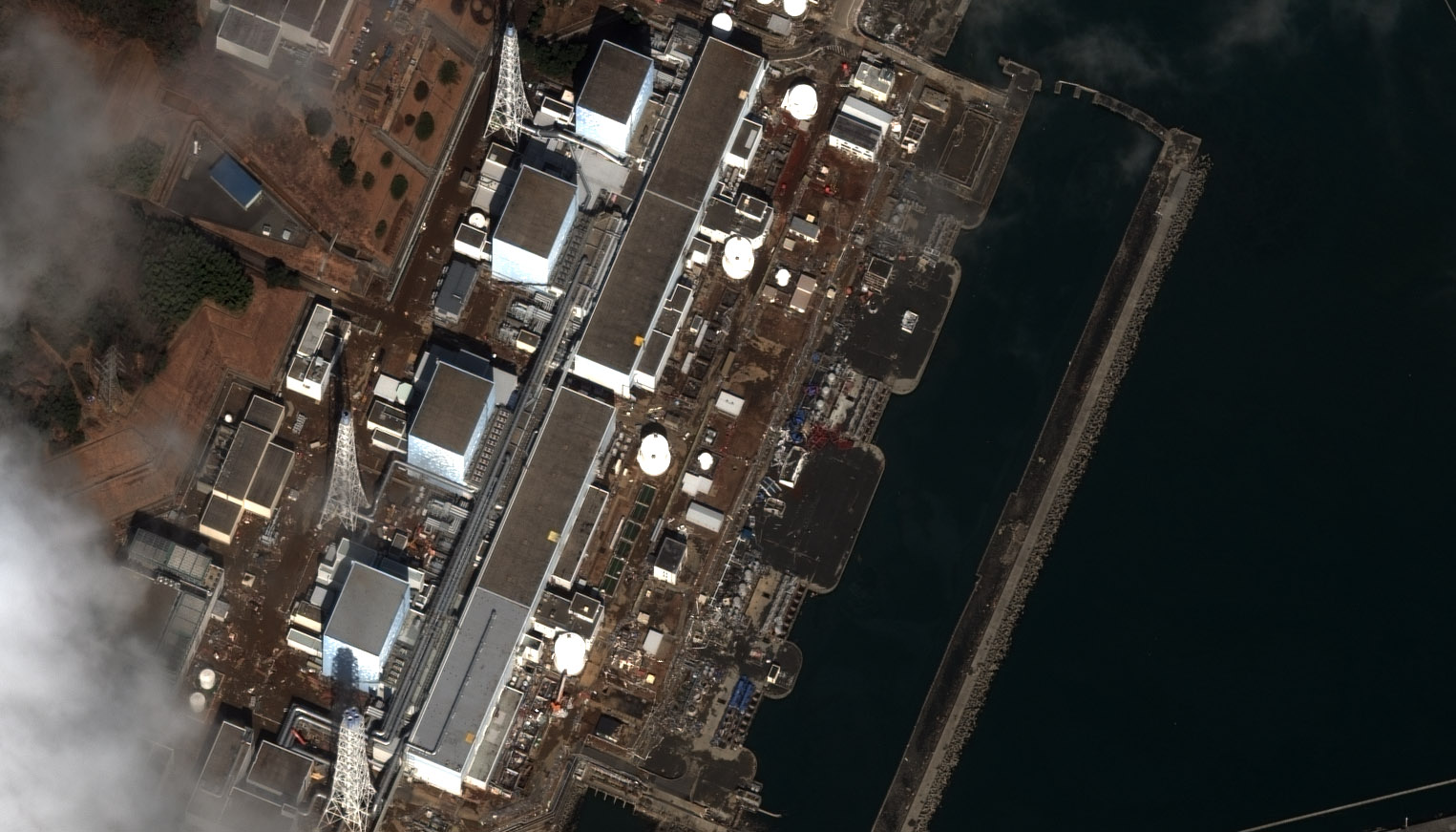
 The Fukushima I (Daiichi) power plant on March 12, 2011 before the earthquake and tsunami.
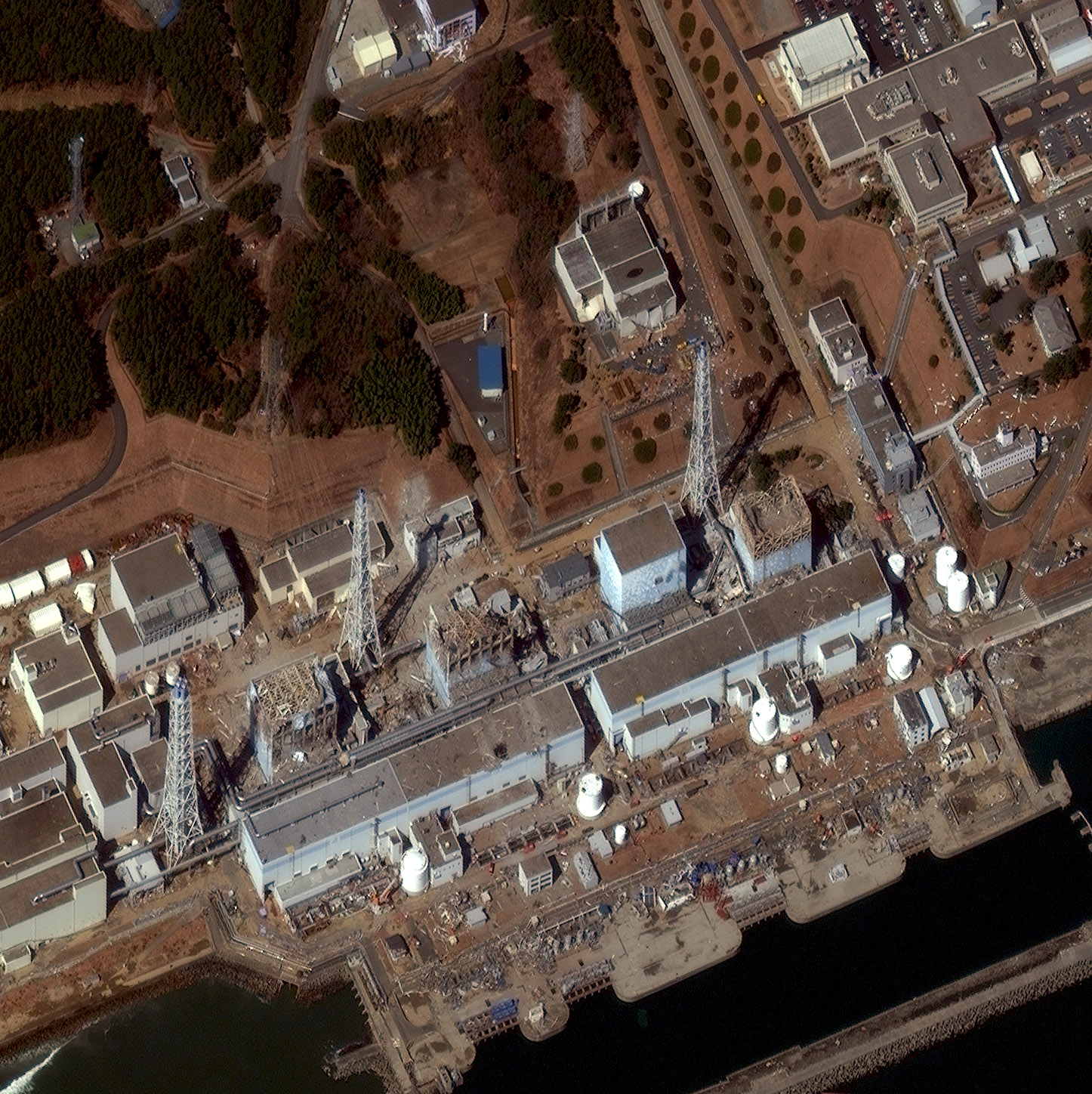 The Fukushima I (Daiichi) power plant on March 16, 2011 after the earthquake and tsunami hit.
Although over 10,000 people died as a result of the March 11 earthquake in Japan (primarily from the tsunami), media attention was also focused on the damage caused to the two Fukushima nuclear power stations. The situation in Fukushima II (the Fukushima Daini plant) was stabilized fairly quickly. The situation in Fukushima I (the Fukushima Daiichi plant), however, with its explosions and releases of radioactive steam prompted a great deal of anxiety among the general public.
The situation in both plants prompted the Japanese government to implement evacuation zones around both plants.
- Click here to see the 20 km (12 mi) evacuation zone around Fukushima Daiichi (Fukushima I).
- Click here to see the 30 km (19 mi) no-fly zone around Fukushima Daiichi (Fukushima I).
- Click here to see the 10 km (6 mi) evacuation zone around Fukushima Daini (Fukushima II).
On March 17, the U.S. Nuclear Regulatory Commission deemed in its analysis of Fukushima Daiichi that the situation was more severe than the Japanese government had publicly admitted, and recommended instead a 50 mile (80 km) evacuation zone around the Fukushima Daiichi plant.
The damage to the Fukushima power plants was magnified by several human decisions. Major decisions that contributed to the Fukushima crisis included:
- Location: The reactors were located on the east coast of Japan, very close to a major fault line. This decision was primarily done for economic reasons since the power plants were then much closer to major population centers (i.e. Tokyo with a population of 13 million.)
- Tsunami Preparedness: Safety regulations to protect power plants from the shaking motion of earthquakes have long been in effect in Japan. Tsunamis, however, have been, until recently, largely ignored as a source of potential damage. It was only in 2006 that government regulations first made official reference to tsunamis. Fukushima Daiichi is located on top of a 4 m (13 ft) bluff. This was deemed high enough to protect the plant from any possible tsunami. In addition, a 5.5 m (18 ft) breakwater had been built offshore to provide protection (mainly for boats) from both typhoons and tsunamis. The actual tsunami that hit the Fukushima Daiichi plant on March 11, 2011 was nearly 14 m (46 ft) high, easily swamping both the seawall and the bluff. The risk of damage from a tsunami had been drastically underestimated and largely ignored despite a 7.8 magnitude earthquake in 1993 producing a tsunami 9.1 m (30 ft) high on Japan’s western coast.
- Backup Power Systems: The earthquake destroyed external power lines and connections leading to the power plants. Backup diesel generators designed to provide power in the event of primary external power failure were not adequately protected against water damage. These diesel generators immediately failed when they were flooded by the tsunami. Emergency battery power designed as a backup to the diesel generators only provided power for 8 hours. These backup batteries failed after their designed life of 8 hours, and no power was then available to carry away residual heat and to cool the reactor cores. It is considered unlikely that there would have been a crisis at the Fukushima power plants had there been adequate protection for the backup power systems.
- Fuel Rod Storage: The design of the reactors used at the Fukushima plants required that spent fuel rods be stored in water above the reactor core. Not only did power to the water pumps for the storage areas fail, but mechanical problems with stuck and damaged water valves also ensued. In addition, the fuel rods were packed much more tightly than was the industry recommended standard (again for economic reasons) leading to rising water temperature issues. The fuel rods were also not stored in primary containment areas with reinforced shielding, but were relatively exposed leaving them vulnerable in case of a nuclear accident.