The greatest damage from earthquakes usually occurs as a direct result of the physical shaking of the Earth caused by the passing of seismic waves. Significant damage, however, can also result from a number of related causes such as liquefaction, landslides, tsunamis, and fires. In this lesson section, we will discuss liquefaction.
 Word Link
Liquefaction refers to ground failure as a result of the shaking of unconsolidated water-logged sediments. The strong shaking of these water-saturated sediments results in the sediments behaving more like liquids than as solids. Liquefaction of the soil results in a rapid lack of ground support for structures. The result is the drastic and uneven settling of buildings and sometimes even the complete toppling of buildings as the ground support gives way.
 Two low-lying areas in San Francisco where damage from the 1906 earthquake was associated with liquefaction and ground failure.
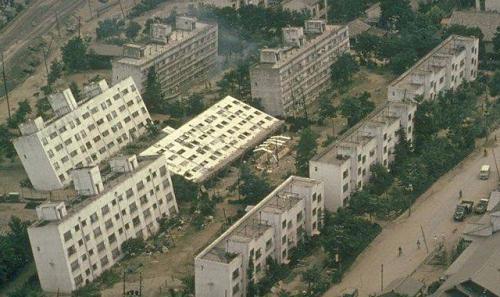 This large apartment building in Niigata, Japan completely toppled over as a result of soil liquefaction in a 1964 earthquake.