Geologists have long known that the location of volcanoes is not random. An examination of the world map to the right shows that the distribution of volcanoes falls into clearly definable areas.
 Did You Know?
Volcanic activity does not only occur here on the Earth. Io, a moon of Jupiter, is considered the most volcanically active body in the solar system. Volcanoes on Io can eject plumes of material (thought to be a combination of sulfur and sulfur dioxide) to a height exceeding a hundred kilometers (62 miles).
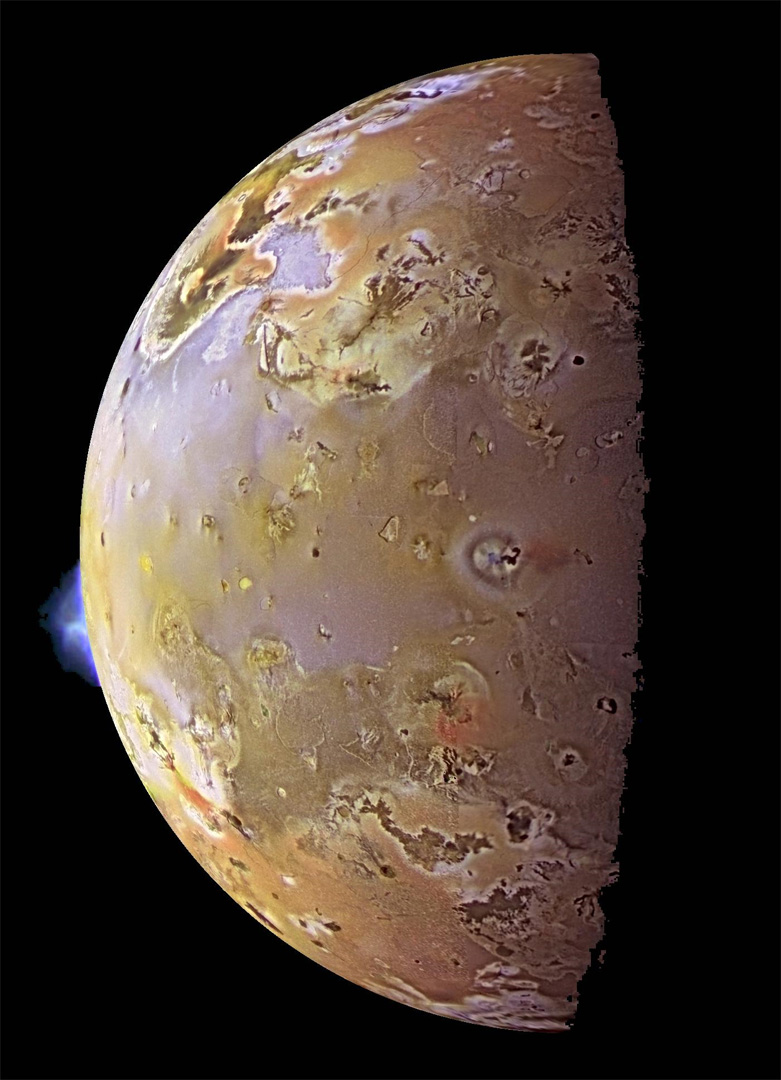
A bluish volcanic eruption is visible on the left edge of Io. This particular eruption ejected material to a height of 140 kilometers (87 miles).
The most obvious location for volcanoes is in a broad 40,000 km (approximately 25,000 miles) band around the Pacific Ocean shaped like a horseshoe. This region contains over three-quarters of the world’s volcanoes and accounts for 90% of the world's earthquakes. It is called the Pacific Ring of Fire.
Another concentration of volcanoes is evident in East Africa in an area called the Great Rift Valley. Yet another collection of volcanoes occurs around Iceland, and at intervals roughly down the middle of the Atlantic Ocean. Finally, the Hawaiian Islands in the mid-Pacific represent another cluster of volcanoes.
The next section will describe geologists’ explanation for the location of these volcanoes.
Learning Activity
Is there a pattern to the location of volcanoes around the world?
Click here and carefully examine the world map of volcano locations.
- What areas do you think show concentrations of volcanoes?
Volcano concentrations are evident in the Pacific Rim, in East Africa, around Iceland, and by the Hawaiian Islands. - Is there anything that you think might be special about these areas?
Many of the volcanic areas are close to plate boundaries.
Click here to view the tectonic plate boundaries.
- Is there a connection between plate boundaries and the location of volcanoes?
Yes, there appears to be a clear link between many of the volcanoes and plate boundaries. The volcanoes around the rim of the Pacific all appear to be linked to plate boundaries. Volcanoes in Iceland also appear to be linked to a plate boundary. - Are there volcanoes that do not appear to be associated with plate boundaries? If so, give at least one example.
Yes, there are a number of volcanoes that appear far from the edges of plate boundaries. The most obvious example is the Hawaiian Islands.
Click here to view the direction the tectonic plates are moving.
- What kinds of plate motion are associated with volcanoes?
Volcanoes appear to be associated with plates that are colliding (convergent plates, i.e., Pacific Rim), or with plates that are separating or pulling apart (divergent plates, i.e., Iceland).