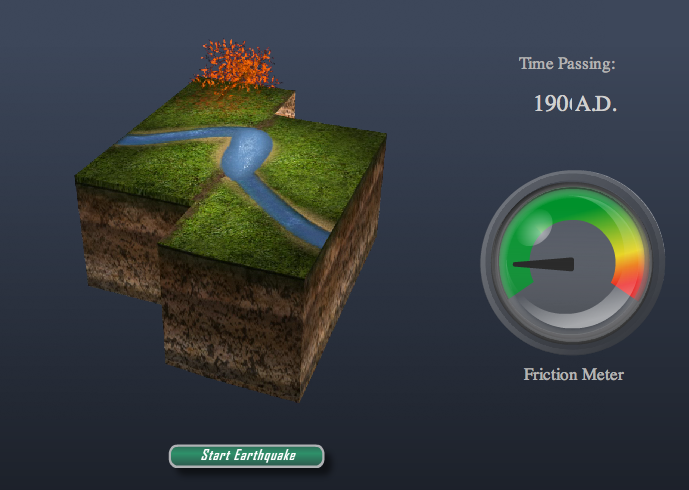
 Interactive animation showing the rapid release of stored energy that causes an earthquake.
Earthquakes happen when parts of the Earth’s crust move past one another at a fault. Our earthquake map shows that the vast majority of these earthquakes occur at tectonic plate boundaries. There is friction between these tectonic plates as they move past one another. This friction can sometimes cause these plates to become temporarily stuck together. Stress slowly builds up over time in these rocks. Eventually, the stress becomes so great that the rocks between the two plates become deformed and break. The plates will now slide, and the stored energy in the rocks as a result of stress is released in a very short period of time. The rapid release of this stored energy is what causes the earthquake.
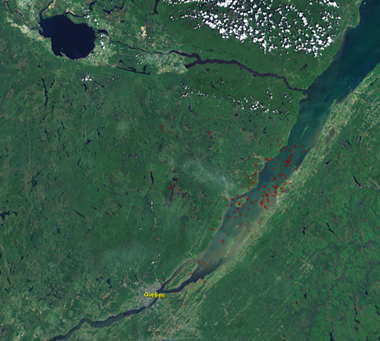 These earthquakes in the St. Lawrence River area occur far from any plate boundary. This area is known as the Charlevoix Seismic Zone.
Earthquakes are common along the San Andreas fault in California as the Pacific plate slides northwest along the North American plate.
Although most earthquakes occur as a result of movement along the Earth’s tectonic plates, earthquakes can occur anywhere there is a fault zone. Significant major earthquakes in the past have occurred near New Madrid, Missouri, and along the St. Lawrence River near the Canada – U.S. (New York state) border. Neither of these areas is anywhere close to a tectonic plate; these earthquakes were instead caused by rock movement in a fault zone. Any rock movement along a fault zone can result in an earthquake.
 Did You Know?
In addition to fault zones, volcanoes can often also produce minor earthquakes. These quakes may be partially due to faults, but are also often related to the movement of molten material in the volcano. The eruption of Mt. St. Helens in Washington on May 18, 1980 was preceded by two months of earthquake activity.