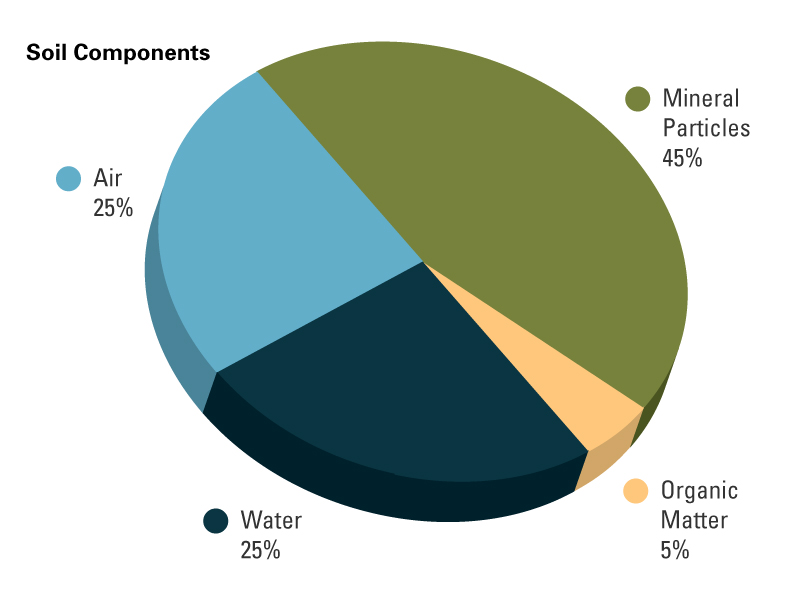
 Typical components of soil.
Soil is a major product of weathering. Soil is a combination of rock and mineral particles, organic matter, water, and air. Soil is important because it contains nutrients that support plant and animal life. Most of the food that we eat is grown in soil.
It may take thousands of years for soil to form. Several factors influence exactly what type of soil is formed.
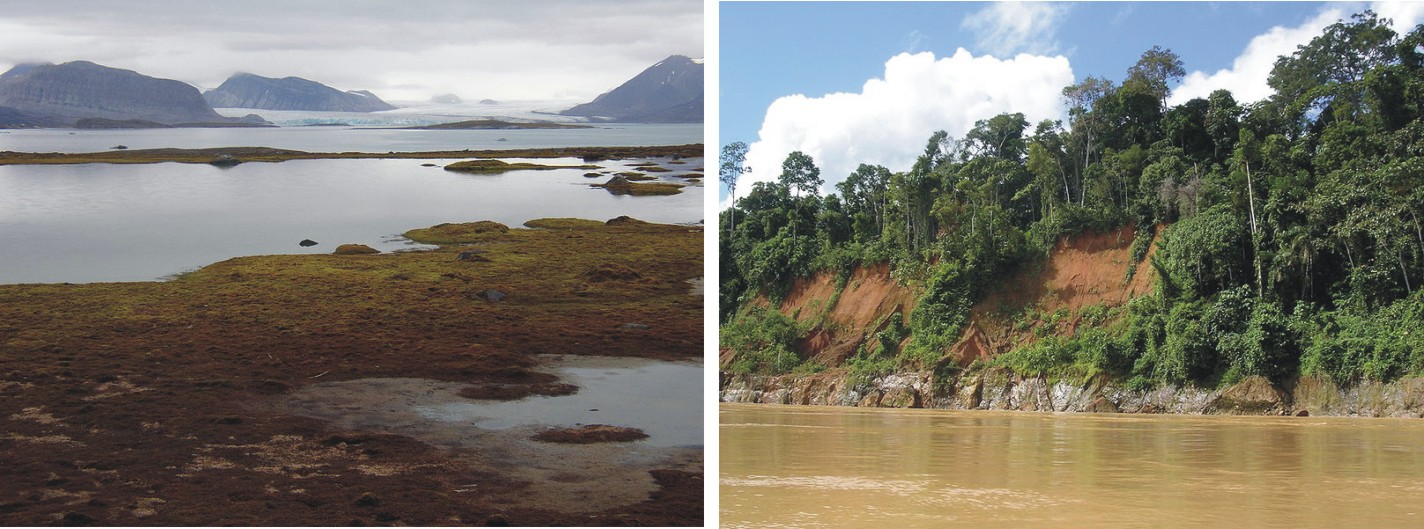 The soil in an arctic tundra is quite different from the soil in a tropical rainforest, primarily because of the climate.
- Climate: Climate is the single most significant factor in the formation of soil. Temperature and precipitation are the two most important climate components affecting soil formation.
- Topography: The shape of the land surface, known as topography, can have a great effect on the type of soil formed. The amount of rainwater runoff, erosion, exposure to wind, and the amount of sunlight received are all factors that are directly related to topography.
- Parent material: Parent material refers to the original material from which the soil is formed. The type of parent material is important because it affects the rate of weathering, and hence soil formation. It also directly affects the fertility of the soil it becomes.
- Plants and Animals: The actions of plants and animals can also influence the type of soil formed. Decaying plant matter, fungi and bacteria, burrowing organisms, and the action of roots are all examples of how plants and animals affect soil formation.
- Time: Time is an important factor in determining the amount of weathering that occurs and thus, how quickly soil forms. The thickness of a soil is directly related to the amount of time that it has had to form.
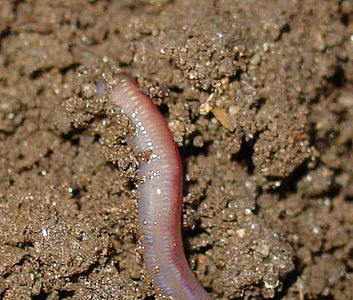 The common earthworm has an active role in soil formation.
 Did You Know?
One teaspoon of rich, fertile soil holds more microscopic organisms than there are people on the whole Earth!
History Link
Learning Activity – Classification of Soil
There is great variety among the soils of the world. Scientists use physical and chemical properties to categorize soil into 12 broad categories. In this exercise, you will examine some of these categories with the aid of the Global Soil Regions map.
- Click here to view the Global Soil Regions map.
Locate where you live either by inspection or by using the Search feature. Zoom in to your home location.
- How is the soil classified where you live? Answers will vary depending on your home location.
Use the measuring tool to measure the distance to the next major soil type closest to where you live.
- What is the next closest soil type to you, and how far away is it? Answers will vary depending on your home location.
- Click here to zoom in on northern Canada.
- What is the major soil type here? Does this make sense? Explain. The major soil type here is permafrost soil (gelisols). This makes sense because the climate does not warm up enough or long enough for the ground to thaw out to any great extent.
- What other part of the world has significant amounts of this major soil type? Russia also has a large amount of permafrost soil.
- Click here to mark the location of London, Oslo, Vienna, and Cairo on the map.
- What is the dominant soil type in London, Oslo, Vienna, and Cairo? London: High nutrient soil (alfisols); Oslo: Conifer forest soil (spodosols); Vienna: Prairie soil (mollisols); Cairo: New soil (entisols)
- Click here to zoom in on the Ukraine.
- The Ukraine, when it was part of the U.S.S.R., was often referred to as the “breadbasket of the Soviet Union.” Explain. The main soil type in the Ukraine is prairie soil (mollisols). Like the prairies of the U.S. and Canada, this soil is excellent for growing grains like wheat; hence its description as a "breadbasket."
- Which continent possesses the greatest amount of tropical forest soils (oxisols)? South America has the greatest amount of tropical forest soil (oxisols).
- Around what river is much of this tropical forest soil clustered? A great deal of this tropical forest soil is centered around the Amazon River.