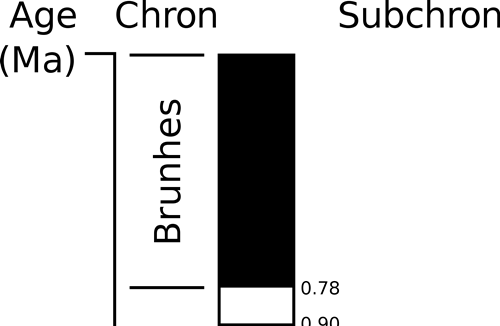
 800,000 years ago the Earth’s magnetic poles were reversed from their current orientation. Black bands represent normal polarity.
It is a well-known fact that a compass needle points towards the north magnetic pole. It is a little known fact, however, that 800,000 years ago this same compass needle would have pointed south instead of north. This is because the magnetic poles have reversed direction. In fact, the magnetic poles have reversed themselves a number of times in Earth’s geologic history between normal polarity (i.e. the north and south magnetic poles are in the orientation that they are today), and reversed polarity (i.e. the north and south magnetic poles are in the opposite orientation than they are today). This phenomenon is known as magnetic reversal. The graphic to the above right (click to enlarge) shows the complete record of the magnetic reversals for the last 5 million years.
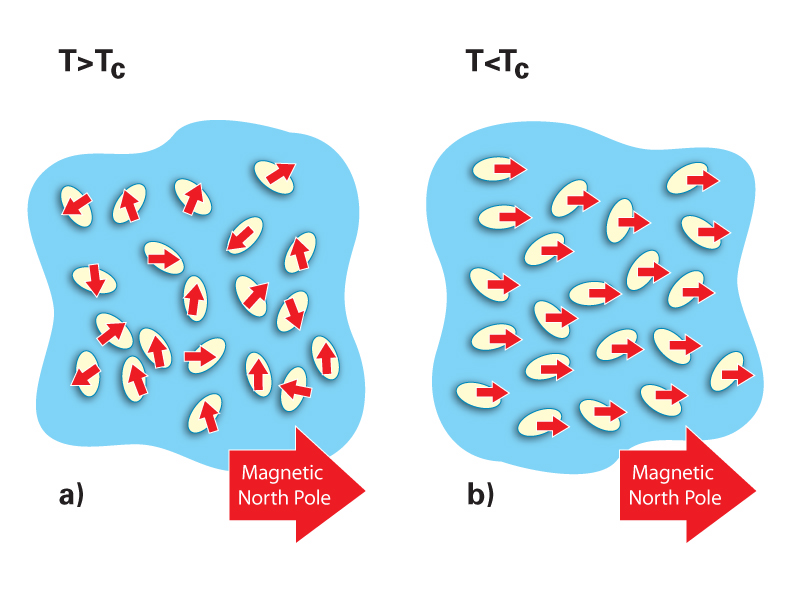 In diagram a) the material has lost all of its magnetic properties because the temperature is above the Curie temperature. In diagram b) the magnetic grains all line up with the magnetic North Pole because the temperature is now below the Curie temperature.
We know that magnetic reversals have occurred in the past because of a physical property of magnetic materials known as the Curie temperature (TC). Magnetic materials lose their magnetism when their temperature exceeds the Curie temperature. Different magnetic materials have different Curie temperatures. However, as these materials cool to temperatures below the Curie temperature, magnetic grains in the material will align themselves with the magnetic poles. As the magnetic materials solidify, a record of the orientation of the magnetic poles is, in effect, “frozen” into them. Magnetite, a common compound of iron-bearing rocks like basalt and the major component of oceanic crust, is often used to investigate the record of the Earth’s magnetic pole reversals.
 Magnetite has a Curie temperature of 585° C (1,085° F).
 History Link
Try This!
History Link
Try This!
Pole Wandering
The location of the north magnetic pole is not fixed in space. Its location changes over time in a phenomenon known as “pole wandering”. As a matter of fact, during the last century the location of the north magnetic pole has moved by approximately 1,100 km (683 miles). Click on each date in order to see the location of the north magnetic pole at that time.