 A tsunami hitting the coast of Thailand. This tsunami was caused by an earthquake off the coast of Sumatra on December 26, 2004 that ultimately resulted in 227,898 casualties. This tsunami caused more casualties than any other in recorded history.
A tsunami is a giant water wave caused by a large underwater disturbance, usually an underwater earthquake. An underwater earthquake forms giant water waves as a direct result of crust slippage along a fault, or the waves can result from an underwater landslide triggered by an earthquake. Tsunamis can also be caused by violent, undersea volcanic eruptions, although this cause is much less frequent.
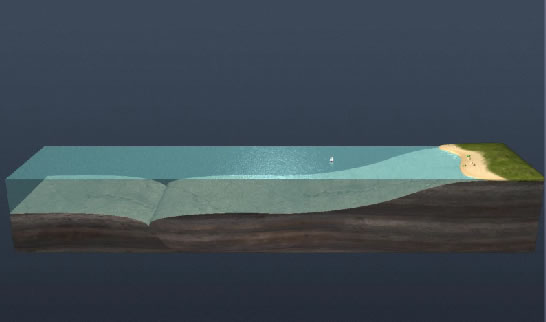 Animation illustrating how water in a tsunami piles up into a large wave in coastal areas.
A tsunami wave can pass virtually unnoticed on the open sea since its amplitude is typically less than 1.0 meter. It is the extremely long length of the water wave, usually extending over hundreds of kilometers, that eventually makes a tsunami so deadly. It is only when approaching shallow coastal waters that the tsunami becomes visible. Friction causes the wave to slow down as it hits shallow coastal waters. The wave begins to pile up upon itself and can reach heights up to 30 meters as it hits the coast.
The devastating tsunami of December 26, 2004 in Indonesia was triggered by a massive earthquake. When the tsunami's wave peak reached the shore, the resulting temporary rise in sea level (termed run up) devasted coastal towns such as Banda Aceh.
 Damage from the December 26, 2004 tsunami is clearly visible in this before and after picture of part of the town of Banda Aceh, Indonesia.
 Word Link
Did You Know?
Word Link
Did You Know?
Learning Activity
Math Link
The March 28, 1964 earthquake in Prince William Sound, Alaska was the largest recorded earthquake (magnitude 9.2) to have ever occurred in North America. The greatest number of fatalities arose as a result of the tsunami that swept through the entire Pacific Ocean basin.
Click here to see a tsunami travel-time map for this earthquake.
- The tsunami travel-time map has lines and numbers (in hours) on it to indicate how long it took the tsunami to travel through the Pacific Basin. What is the time interval between each pair of lines? The interval is 1 hour.
Click here to add 5 locations to our map. Examine the map carefully and determine how long it took the tsunami to reach:
-
- San Francisco, U.S.A. approximately 5 hours, 30 minutes
- Acapulco, Mexico just past 10 hours
- Galapagos Islands approximately 13 hours, 30 minutes
- Tokyo, Japan approximately 8 hours, 20 minutes
- Sydney, Australia approximately 16 hours, 40 minutes
-
- Use the distance measuring tool and determine the average speed of the tsunami wave for each interval between the 5 hour and 10 hour lines. Since each time interval is 1 hour, measuring the distance will give a direct figure for the average speed. The actual value will vary depending on what part of the Pacific Ocean basin is actually measured.
- What do you observe? Independent of where the distance is actually measured, the average speed of the tsunami wave is slowly decreasing.
- Can you explain this? Friction is the usual explanation for this.
- Prince Rupert in British Columbia, Canada had a measured wave height of 1.4 m, while Astoria, Washington further south had a measured wave height of 0.4 m. Why is this an expected result? This is expected because generally, increased distance from the earthquake hypocenter should result in a smaller tsunami wave as the wave slowly dies out due to friction.
- Port Alberni in British Colombia, however, which is between Prince Rupert and Astoria had a wave height of 6.4 m. Can you think of a reason why the tsunami wave was higher in Port Alberni than in either of Prince Rupert or Astoria? Click here to travel to Port Alberni to give you a clue. Port Alberni is found at the end of a long, narrow channel. The channel served to funnel the water, dramatically increasing the height of the tsunami wave.