E3-3
Locating an Earthquake
 Did You Know?
The fact that P and S waves travel at different speeds is key to locating where an earthquake has occurred.
Scientists use the time difference between the arrival of the P and S waves to determine how far away an earthquake occurred. If the earthquake is close by, then the time difference between the arrival of the P and S waves will be very short. However, if the time difference is quite large, then the earthquake is far away.
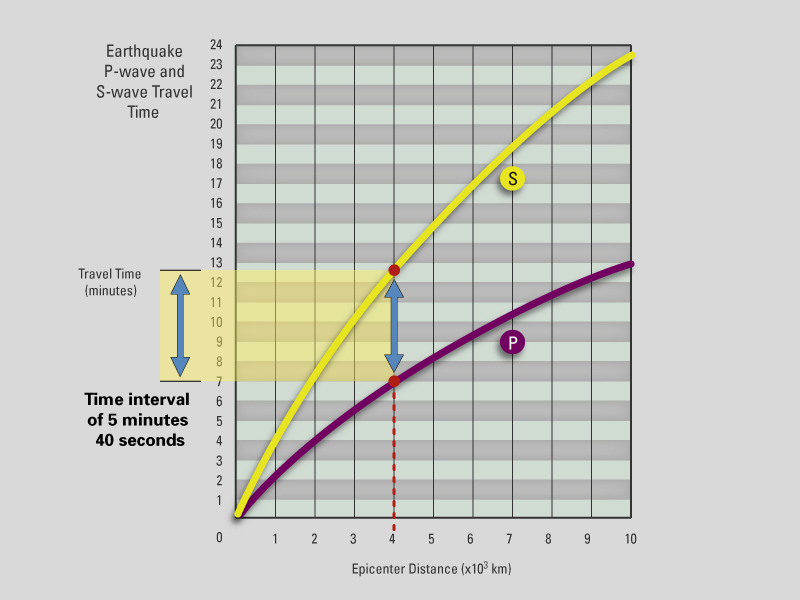 A time delay between the arrival of the P and S waves of 5 minutes and 40 seconds corresponds to a distance of approximately 4,000 km.
Geologists have used many careful observations to prepare a standardized travel-time graph for P and S waves. The difference between the arrival times of the P and S waves can be used on the travel-time graph to directly read the distance from the epicenter of the earthquake.
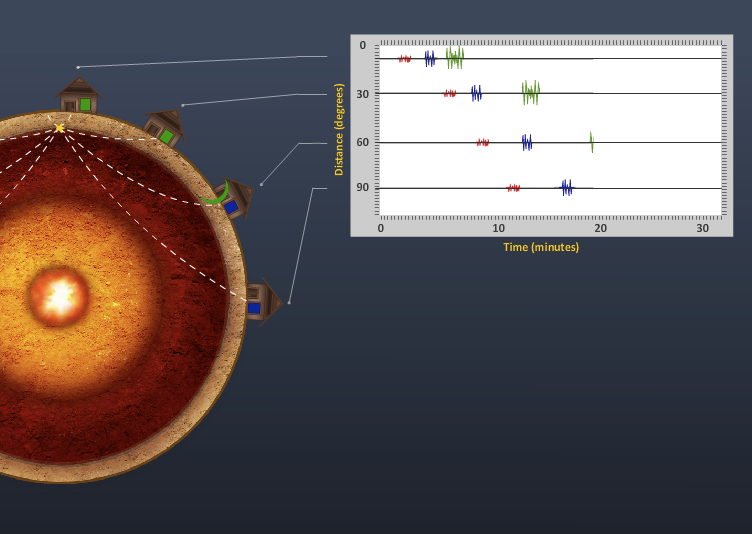 Animation illustrating the creation of the travel-time graph for P and S waves.