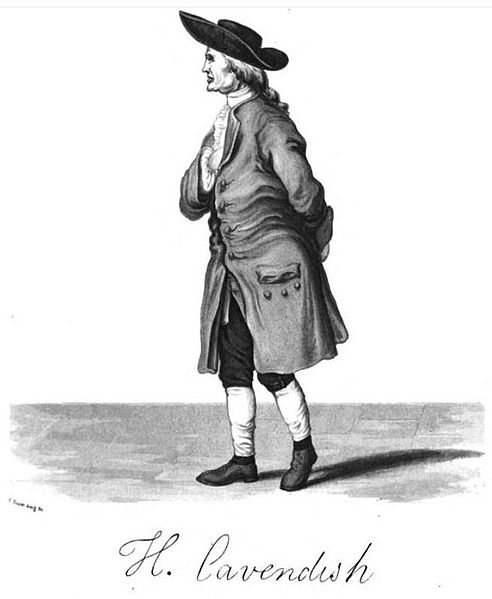
 Henry Cavendish was known in his time as “the man who weighed the Earth.”
Much of our current knowledge about the composition of the Earth’s interior comes from an analysis of seismic waves produced by earthquakes. Early indications that the interior of the Earth was quite different from the Earth’s surface, however, came from quite different sources.
 Did You Know?
Math Link
Did You Know?
Math Link
In 1798, English physicist Henry Cavendish (1731–1810) performed an experiment that involved measuring the gravitational pull between two large lead masses. He then compared this with the gravitational pull that the Earth exerted on those same masses. From this, Cavendish was able to calculate a value for the mass of the Earth. When Cavendish then divided this mass of the Earth by its volume, he was able to get the first determination for the density of the Earth. Cavendish published a figure of 5.48 g/cm3 as the average density for the Earth. Scientists were quite impressed by this result since Cavendish was the first person to have been able to do such a calculation. Scientists also later recognized that Cavendish’s result was quite significant because it was different from the average density of surface rocks, a value that had been determined to be 2.8 g/cm3 . This led scientists to conclude that somewhere inside the Earth there must be a drastic change in composition. This material, or materials, must be much denser in composition than the rocks on the Earth’s surface.
Did You Know?
The next step was taken by French geologist Gabriel Auguste Daubrée (1814–1896) in 1866. Daubrée had noticed that many meteorites had high concentrations of nickel-iron. Daubrée then proposed in 1866 (correctly, as it turns out) that the Earth’s core was also composed primarily of nickel-iron, and that this would then account for the Earth’s high average density.