Mark Twain's First Earthquake
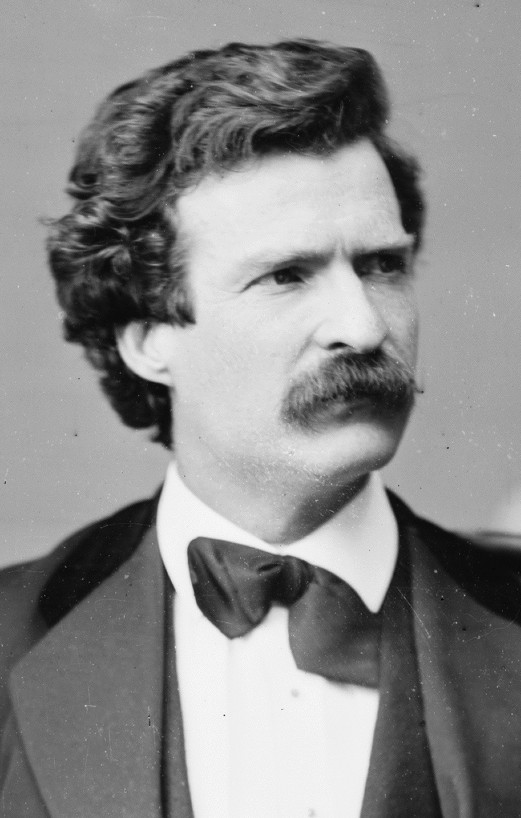 Mark Twain portrait. Photographed February 7, 1871.
Mark Twain (1835–1910) is best known as the author of works such as The Adventures of Huckleberry Finn, The Prince and the Pauper, and The Adventures of Tom Sawyer. In one of his earlier works, Roughing It, he recounts his adventures traveling through the Wild West during the years 1861–1867. During this time he experienced his first earthquake in the fall of 1865 in San Francisco. Here is a brief excerpt of his experience:
It was just after noon, on a bright October day. I was coming down Third street. The only objects in motion anywhere in sight in that thickly built and populous quarter, were a man in a buggy behind me, and a street car wending slowly up the cross street. Otherwise, all was solitude and a Sabbath stillness. As I turned the corner, around a frame house, there was a great rattle and jar, and it occurred to me that here was an item! - no doubt a fight in that house. Before I could turn and seek the door, there came a really terrific shock; the ground seemed to roll under me in waves, interrupted by a violent joggling up and down, and there was a heavy grinding noise as of brick houses rubbing together. I fell up against the frame house and hurt my elbow. I knew what it was, now, and from mere reportorial instinct, nothing else, took out my watch and noted the time of day; at that moment a third and still severer shock came, and as I reeled about on the pavement trying to keep my footing, I saw a sight! The entire front of a tall four-story brick building in Third street sprung outward like a door and fell sprawling across the street, raising a dust like a great volume of smoke!
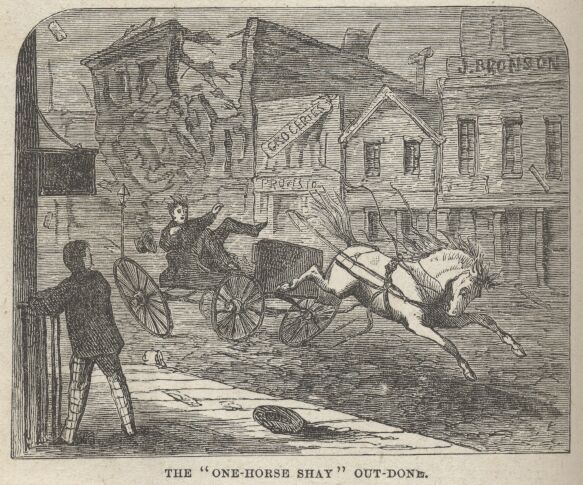 The "one-horse shay" out-done.
And here came the buggy - overboard went the man, and in less time than I can tell it the vehicle was distributed in small fragments along three hundred yards of street.
One could have fancied that somebody had fired a charge of chair-rounds and rags down the thoroughfare. The street car had stopped, the horses were rearing and plunging, the passengers were pouring out at both ends, and one fat man had crashed half way through a glass window on one side of the car, got wedged fast and was squirming and screaming like an impaled madman. Every door, of every house, as far as the eye could reach, was vomiting a stream of human beings; and almost before one could execute a wink and begin another, there was a massed multitude of people stretching in endless procession down every street my position commanded...
... A prominent editor flew down stairs, in the principal hotel, with nothing on but one brief undergarment - met a chambermaid, and exclaimed:
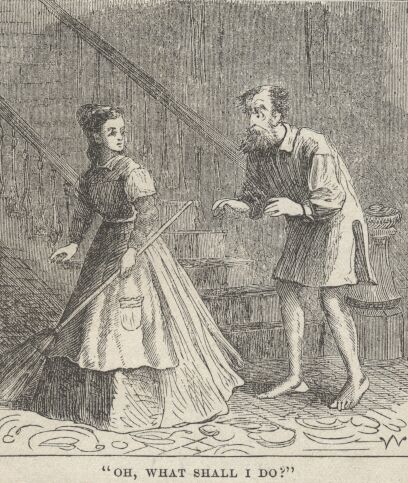 "Oh, what shall I do?"
"Oh, what shall I do! Where shall I go!"
She responded with naive serenity:
"If you have no choice, you might try a clothing-store!"...
... The plastering that fell from ceilings in San Francisco that day, would have covered several acres of ground. For some days afterward, groups of eyeing and pointing men stood about many a building, looking at long zig-zag cracks that extended from the eaves to the ground. Four feet of the tops of three chimneys on one house were broken square off and turned around in such a way as to completely stop the draft.
A crack a hundred feet long gaped open six inches wide in the middle of one street and then shut together again with such force, as to ridge up the meeting earth like a slender grave. A lady sitting in her rocking and quaking parlor, saw the wall part at the ceiling, open and shut twice, like a mouth, and then-drop the end of a brick on the floor like a tooth. She was a woman easily disgusted with foolishness, and she arose and went out of there. One lady who was coming down stairs was astonished to see a bronze Hercules lean forward on its pedestal as if to strike her with its club. They both reached the bottom of the flight at the same time, - the woman insensible from the fright. Her child, born some little time afterward, was club-footed. However - on second thought, - if the reader sees any coincidence in this, he must do it at his own risk.
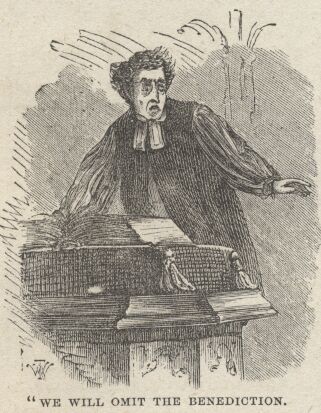 "We will omit the benediction"
The first shock brought down two or three huge organ-pipes in one of the churches. The minister, with uplifted hands, was just closing the services. He glanced up, hesitated, and said:
"However, we will omit the benediction!" - and the next instant there was a vacancy in the atmosphere where he had stood.
After the first shock, an Oakland minister said:
"Keep your seats! There is no better place to die than this"
And added, after the third:
"But outside is good enough!" He then skipped out at the back door.
Questions for Comprehension and Understanding:
- When did the earthquake occur?
The earthquake occurred just after noon on an October day. - What did Twain initially think was causing the "great rattle and jar"?
He initially thought it was a fight in a house. - What happened to the man and his buggy?
The man was thrown from the buggy, and the buggy itself was destroyed; "the vehicle was distributed in small fragments along three hundred yards of street." - Describe some of the damage that Twain saw after the earthquake.
Plaster had fallen from ceilings, many buildings had "long zig-zag cracks," chimneys toppled, and a crack a hundred feet long and six inches wide was visible in the middle of a street. - Twain was well known as a humorist. How does this excerpt illustrate this?
He recounts some funny misadventures that happened to certain individuals like the prominent editor who came downstairs with only brief undergarments on, or the minister who said that it was fine to die in church, but who after another earthquake shock decided that being outside was better.