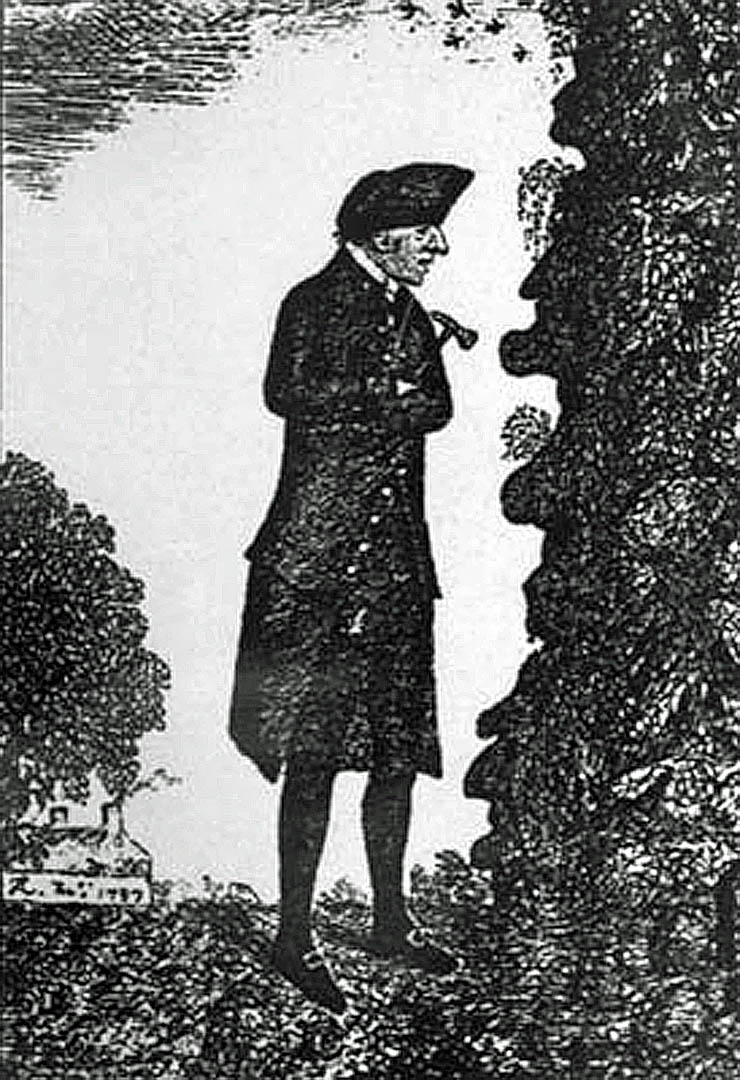
 James Hutton examining rocks in the field.
The Earth is currently estimated to be approximately 4.6 billion years old. Scientists have used a number of methods to date the Earth. One of the most common methods is to date the ages of rock. Regardless of the methods used, scientists rely on the belief that geologic processes at work on the Earth today were also at work long ago. This principle, which underlies all of geology, is known as uniformitarianism. The concept of uniformitarianism is credited to James Hutton (1726–1797), a Scottish physician and gentleman farmer, who in 1788 presented a paper to the royal Society of Edinburgh describing what we today call the rock cycle. Historians credit this meeting as marking the formal introduction of the principle of uniformitarianism.
 Did You Know?
Uniformitarianism is also a vital component in other realms of science. In astronomy, this principle allows us to use the speed of light to determine how far away distant celestial bodies are. Astrophysicists rely on the assumption that the speed of light in the past was the same as it is today. Astrophysicists make use of the light year in order to describe these large distances. A light year, 9.5 × 10⁹ km (5.88 × 10¹² miles), is a unit of distance which corresponds to the distance that light will travel in one year.
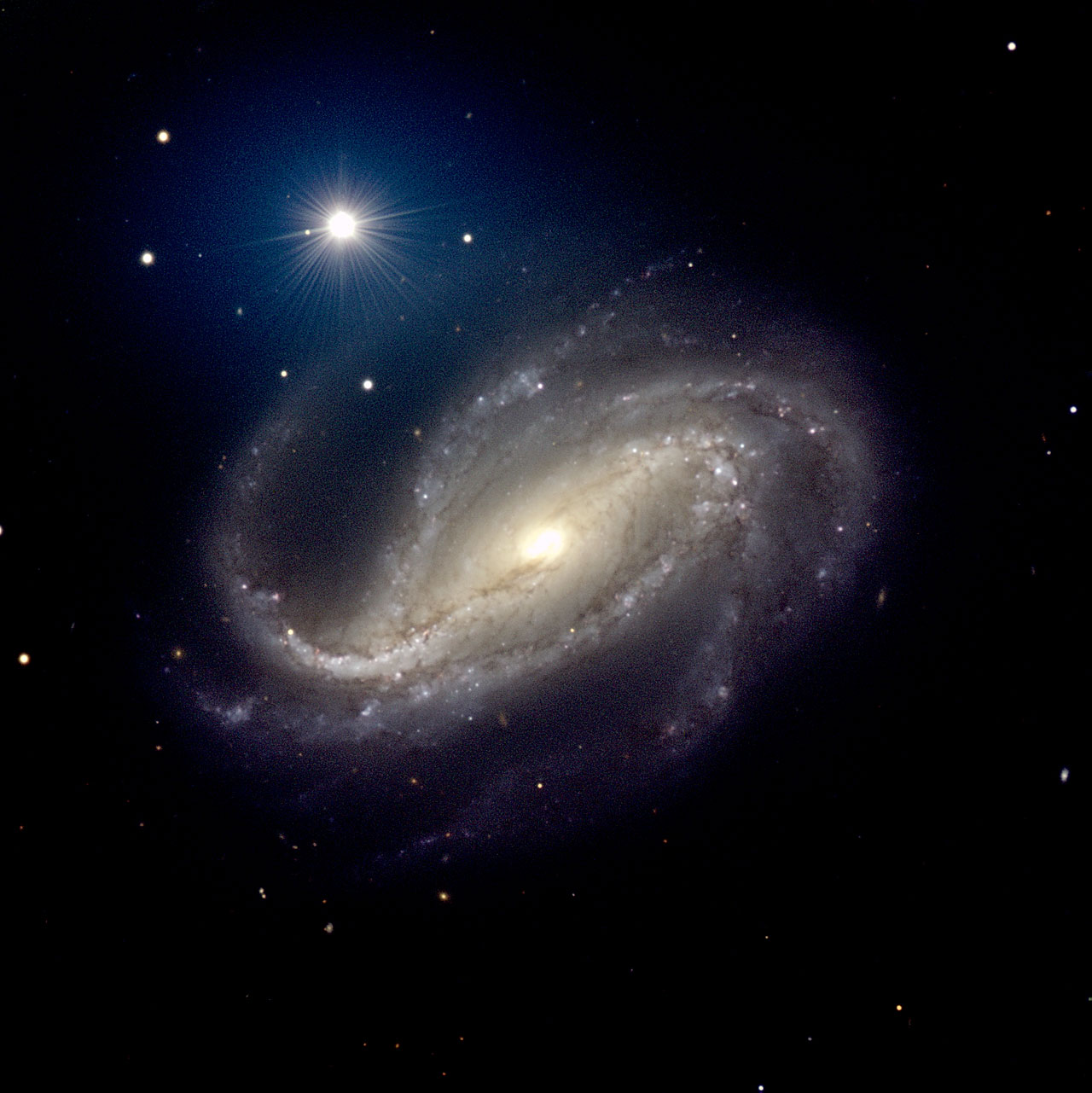
Galaxy NGC 613 is 65 million light years away. This means that the light we now see from NGC 613 was emitted 65 million years ago, when the dinosaurs became extinct.
Word Link
Try This!
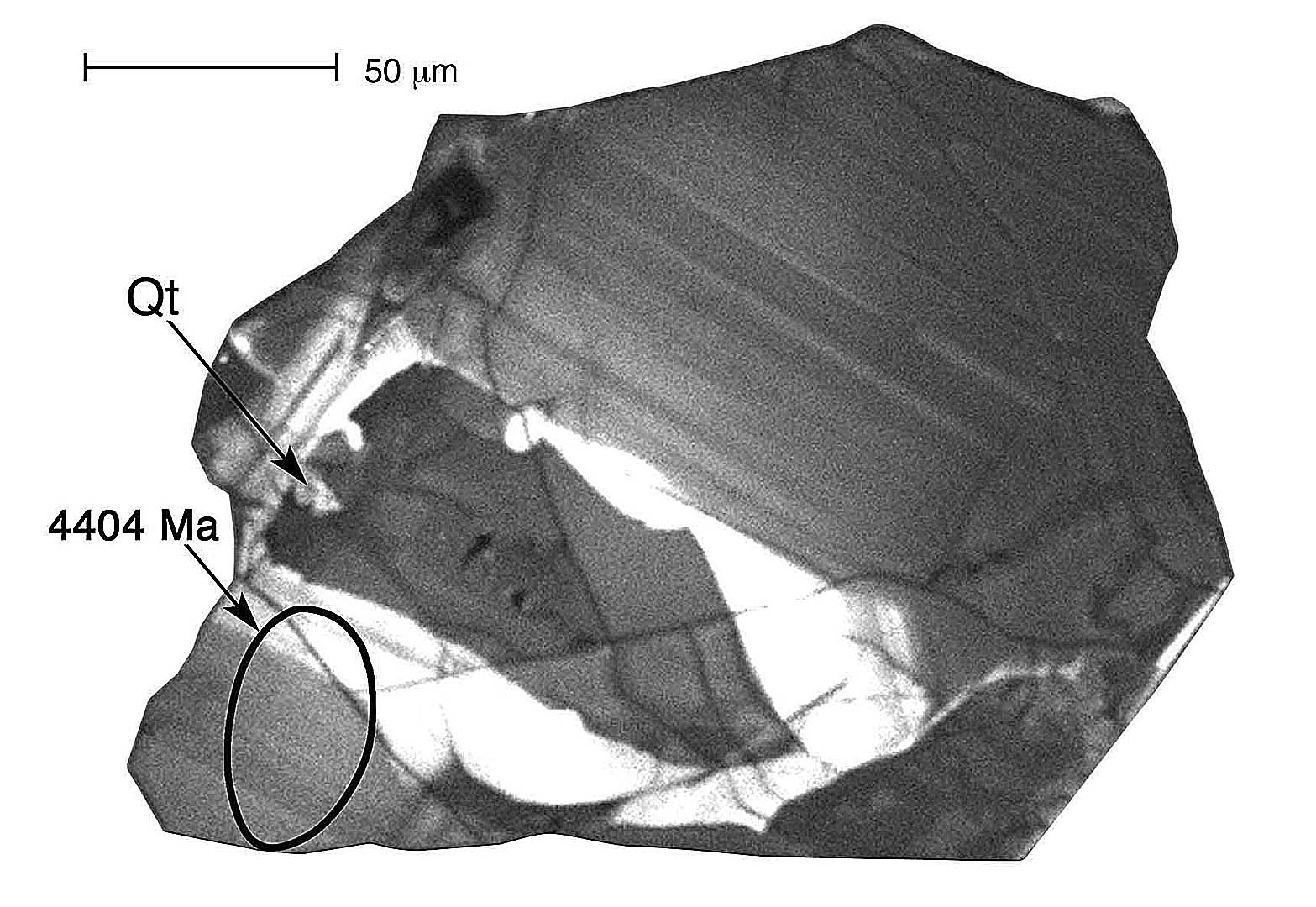 A microscopic view of a single 4.404 billion year old zircon crystal from Jack Hills.
Being Old and Gneiss
Although grains of the mineral zircon embedded in conglomerate at Jack Hills in Australia have been dated to 4.404 billion years making the Jack Hills zircons the oldest known material of terrestrial origin, the actual record for the oldest intact rocks on Earth belongs elsewhere.
Great Bear Lake in Canada’s Northwest Territories is the world’s seventh largest lake. In a remote area east of Great Bear Lake scientists in 1989 discovered the oldest rocks in the world. Scientists have dated these rocks, known as the Acasta Gneiss, to an age of 4.031 billion years. The term “Acasta” comes from the nearby Acasta River. Gneiss is a common form of metamorphic rock. (For more information about metamorphic rocks see C3-5: Formation of Metamorphic Rock and C3-6: Types of Metamorphic Rock.)
- Click here to locate the Acasta Gneiss
- Click here to locate the Acasta River.
Other Oldies: Very old rocks have been discovered in several other areas of the world. Click on each name in the table below in order to visit that rock formation.
| Formation Name | Location | Age of Rock |
| Nuvvuagittuq Greenstone Belt | Quebec, Canada | ≈3.8 billion years (Earlier estimates had placed the age of this formation at 4.28 billion years, but this age estimate is in dispute.) |
| Isua Greenstone Belt | Greenland | 3.7 – 3.8 billion years |
| Narryer Gneiss Terrane | Australia | >3.6 billion years (The Jack Hills zircons are part of the Narryer Gneiss Terrane.) |
| Morton Gneiss | Minnesota, U.S. | 3.6 billion years |