The Earth has been in existence for about 4.6 billion years. What, however, does the future hold? Do we know what the expected lifetime for the Earth is? These questions can be answered from at least two perspectives.
The Death of Plate Tectonics
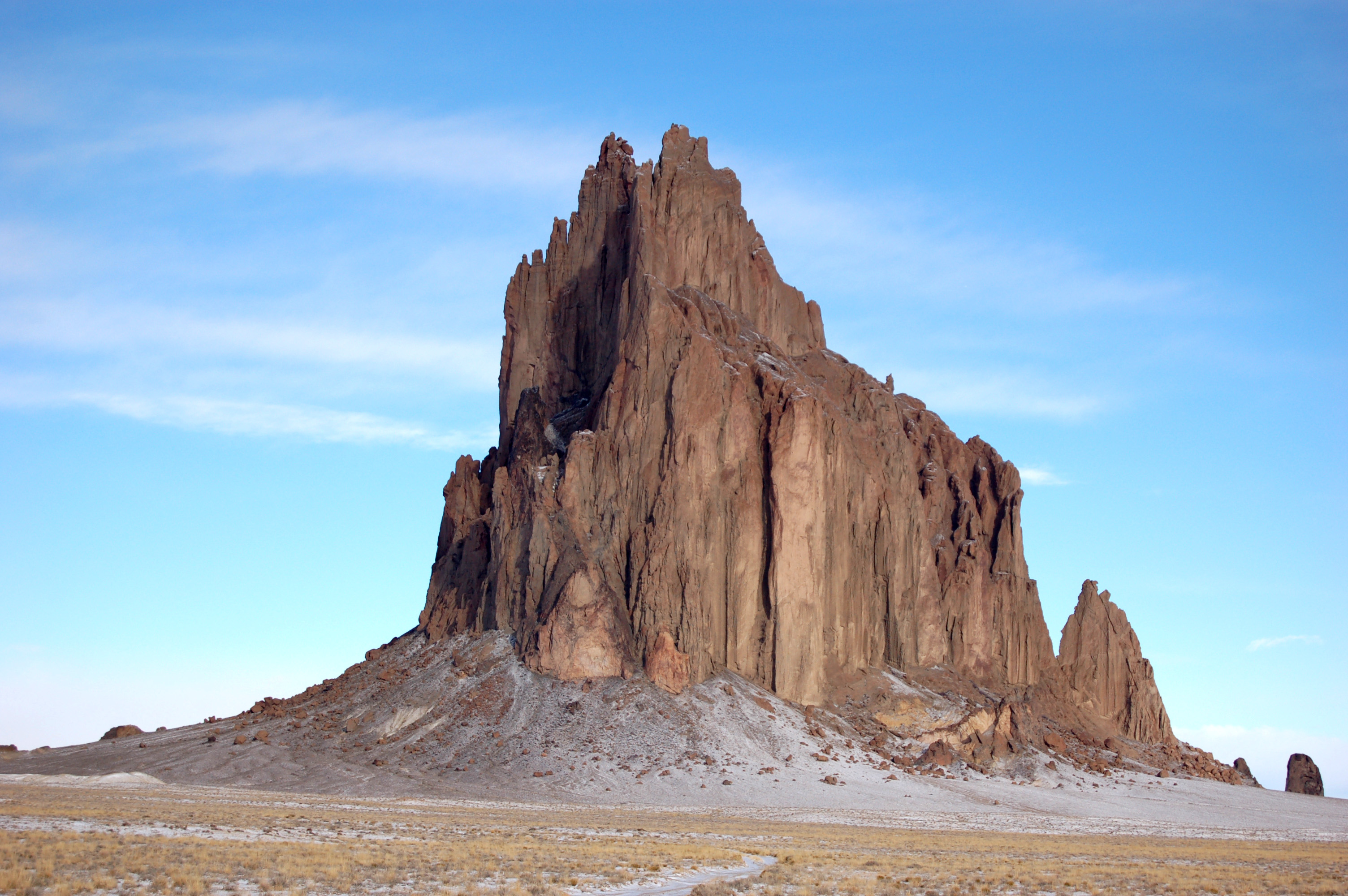 Shiprock, the eroded remnant of the throat of an extinct volcano. Volcanism would cease if the Earth’s internal heat sources were to be used up.
Geologic activity on our planet is primarily driven by plate tectonics. If plate motion were to cease, then earthquakes and volcanism would come to an end. Erosion and weathering would then eventually reduce the continents to a bland uniform elevation. How realistic is this scenario?
The Earth’s tectonic plates are driven by sources of heat from within the Earth. The prime source of this heat is the radioactive decay of elements such as uranium-238 (U238) and thorium-232 (Th232). (See Lesson A2 – Earth’s Layered Structure / Where Does the Heat Come From? for more on this.) U238 has a half-life of 4.5 billion years, while Th232 has a half-life of 14 billion years. It is clear that there is enough radioactive material to provide internal heat for the Earth and to drive its tectonic plates for billions of years to come. The end of the Earth will probably come from a different source.
The Death of the Sun
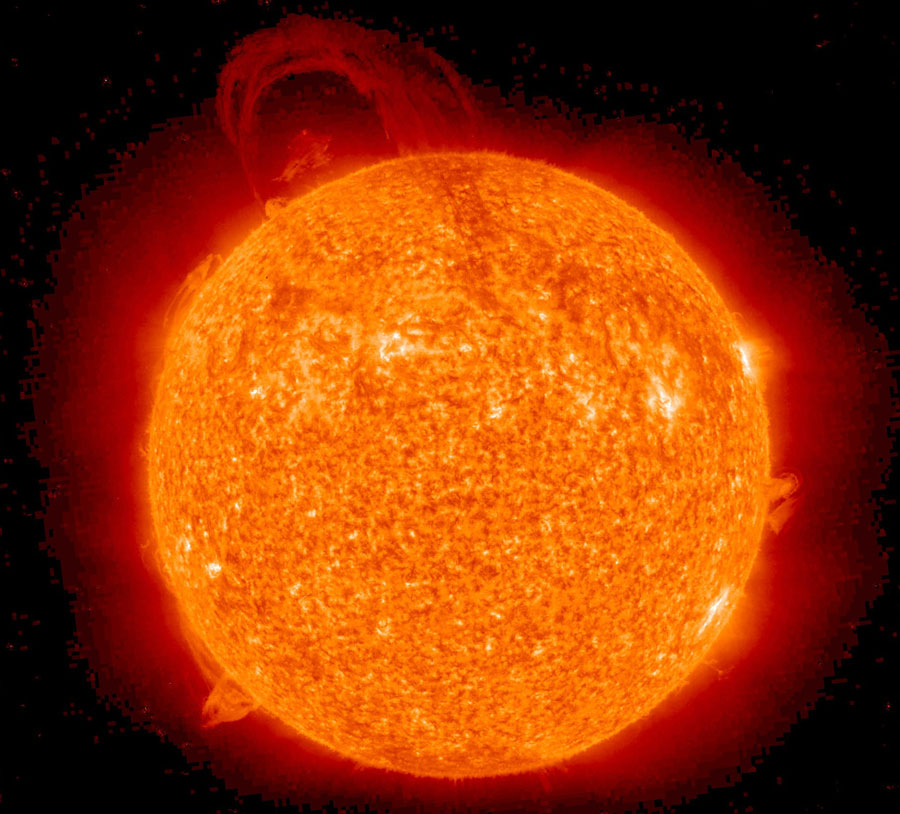 Our sun is an average star.
 Work Link
The sun is a fairly standard star. It produces energy by converting hydrogen into helium in a process known as nuclear fusion. In nuclear fusion, the nuclei of light atoms (i.e., hydrogen) are combined together to produce nuclei of heavier atoms (i.e., helium). A great deal of energy is released in the process. The heat produced by fusion causes an outward pressure on the sun. This outward pressure, however, is exactly balanced by the inward attraction of gravity. This ongoing balance results in our sun being a steady, stable star with a regular energy output.
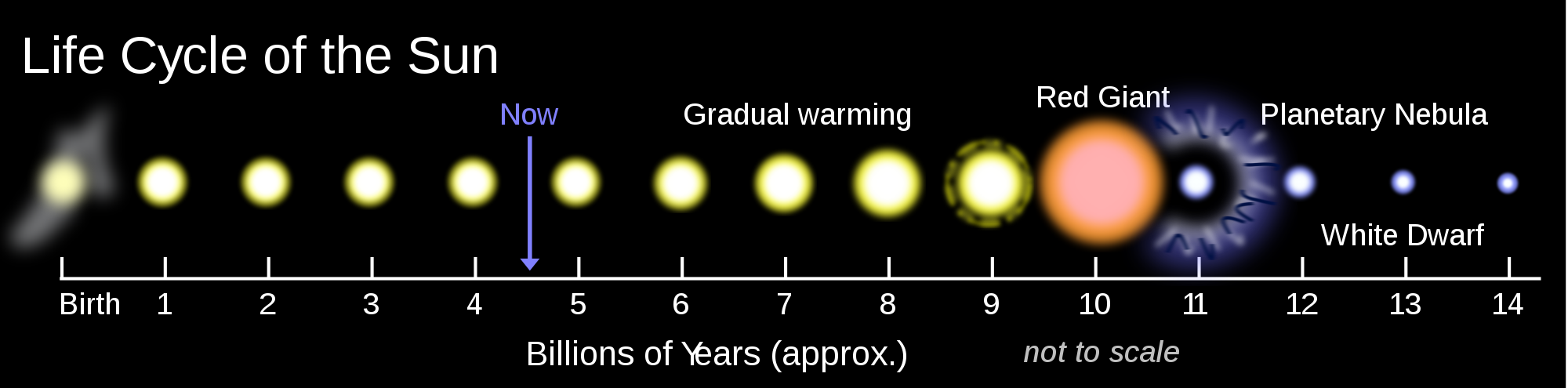 The life cycle of our sun indicating when it will become a red giant.
In about 5 billion years, however, the sun will have used up most of its hydrogen resources. A balance will no longer exist between pressure and gravity. The outer layers of the sun will expand and it will become what is known as a red giant. The sun will have expanded enough to engulf both Mercury and Venus. It is unclear whether the sun would expand enough to engulf the Earth, but even if it didn’t, tidal attraction would eventually cause the Earth to fall into the sun. The Earth’s biosphere would have been destroyed by heat from the expanded sun long before the Earth is physically engulfed by the sun. The Earth will thus meet its ultimate fate not from the death of plate tectonics due to internal heat loss, but from the sun reaching the end of its life cycle.
Did You Know?
The sun contains almost 1,000 times as much matter as all other objects in the solar system put together. It needs all this mass since the sun loses approximately 4 billion kilograms (about 2 million pounds) of mass every second as it converts hydrogen into helium by the process of nuclear fusion.