Turkey as a country is very prone to earthquakes. The view to the right in the main view panel shows several major earthquakes that have occurred in the region in the past 100 years.
- Click here to add in the magnitude 7.8 and 7.7 quakes that occurred on Feb. 6, 2023.
The historical location of the earthquakes clearly seems to indicate a definite pattern and area within which earthquakes occur in this region.
In addition to the two large earthquakes, a number of smaller earthquakes also occurred on Feb. 6.
- Click here to see the locations of 73 earthquakes on Feb. 6, 2023.
The size of the circle corresponds to the magnitude of the earthquake.
- Attempt to locate the two biggest circles that correspond to the earthquakes of magnitude 7.8 and 7.7.
- Click here to add in labels showing the locations of the two biggest earthquakes (did you get the right ones?).
These earthquakes are clustered around a region known as the East Anatolian Fault.
- Click here to see the East Anatolian Fault.
- Click here to add in the location of our two major earthquake sites.
So why is this fault here? The East Anatolian Fault is actually the boundary between two tectonic plates that are interacting.
- Click here to see the Arabian Plate.
- Click here to see the Anatolian Plate.
The East Anatolian Fault is a 700 km (435 mi.) long transform fault. The earthquakes on February 6, 2023 were the result of the Arabian Plate sliding horizontally past the Anatolian Plate.
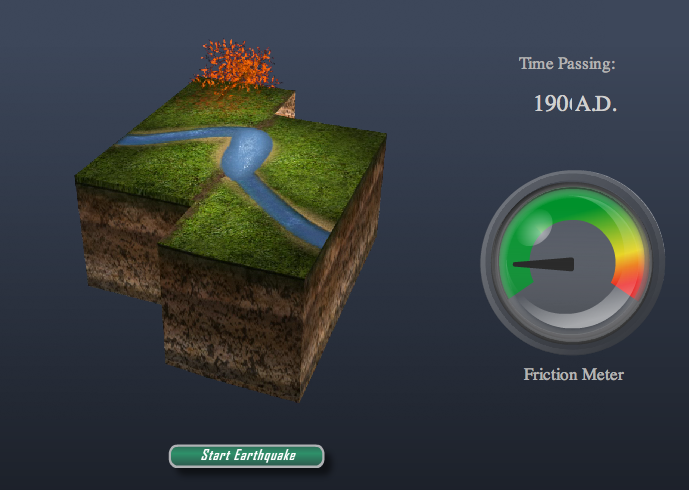 Interactive animation showing the rapid release of stored energy that causes an earthquake.
 Did You Know?
Triple Threat
Although the Feb. 6 earthquakes were the result of tectonic stresses between the Anatolian and the African Plates, a nearby third tectonic plate has also contributed to earthquakes in the past in Turkey.
The African Plate forms a convergent boundary where it meets the Anatolian and the Arabian Plates. The point where all three plates meet is known as a “triple point”.