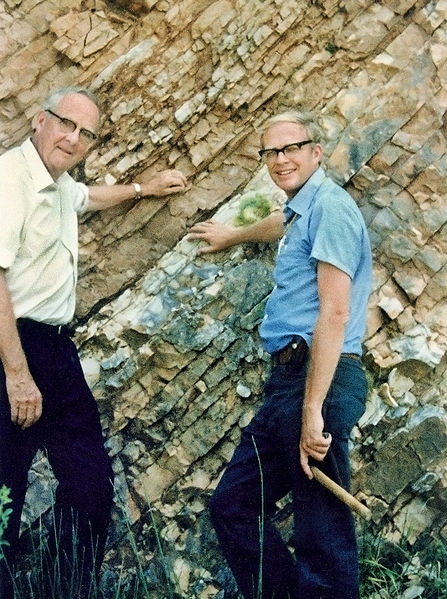
 Luis and Walter Alvarez proposed the asteroid impact theory to explain dinosaur extinction in a seminal 1980 paper.
The mass extinction at the end of the Late Cretaceous (approximately 65.5 million years ago) was the world’s second largest mass extinction. It resulted in approximately 75% of all species disappearing from the Earth. Prominent among these species, of course, were the dinosaurs.
 High levels of iridium at the K-T boundary support the asteroid impact theory.
Most scientists now agree that this extinction event, which marks the division between the Cretaceous and the Tertiary Periods, was the result of a large asteroid impact approximately 65.5 million years ago. This explanation, known as the asteroid impact theory, stems from the 1980 discovery that sedimentary layers at the Cretaceous-Tertiary boundary, known as the K-T boundary, exhibited extremely high levels of iridium.
Iridium is quite rare in the Earth’s crust, but it is very common in asteroids and comets. Not only was the iridium level high at the K-T boundary, but subsequent investigations showed that this high level of iridium at the K-T boundary could be found at locations all around the world. It was estimated that an impact with a 10-kilometer-wide (approximately 6-mile-wide) asteroid could have caused this high level of iridium in the sedimentary layers.
Unlike the moon, which shows the scars of numerous asteroid impacts, known as craters, the Earth has very few visible craters. This is because the atmosphere protects us from smaller debris, and weathering and erosion gradually obliterate any large craters that are formed. In 1990, however a crater was identified on the Yucatan Peninsula in Mexico. This crater, known as the Chicxulub Crater, has undergone much investigation since its discovery. Scientists are now in general agreement that this crater is solid evidence proving the asteroid impact theory.
Although the Chicxulub Crater is obscured from view by dense forest and ocean, its circular outline is very apparent in a gravitational anomaly map of the Yucatan Peninsula.
Learning Activity: The Diameter and Center of the Chicxulub Crater
 Did You Know?
- Click here to view an outline showing the size of the Chicxulub crater.
Use the measuring tool to calculate the approximate diameter of the crater.
- What is the approximate diameter of the Chicxulub crater? The crater is approximately 180 kilometers wide (approximately 112 miles wide).
- How far from the town of Chicxulub is the center of the crater? The town of Chicxulub is approximately 30 kilometers (approximately 19 miles) from the center of the Chicxulub crater.
History Link
The asteroid impact that created the Chicxulub Crater would have obliterated all life in the immediate area. A huge and devastating tsunami would also have been created by the impact event. It is thought, however, that the greatest effects on the environment and the food chain would have been caused by:
Word Link
- the huge amount of ash and debris in the atmosphere which would have blocked the sun’s rays resulting in global cooling.
- acid rain that formed as large amounts of sulfur and nitrogen gases were released into the atmosphere; this acid rain would be toxic to much of the food chain.
The locations of other craters on Earth are also known. Click here to view their locations.