E3
Math Link - The Richter Scale
- When compared to an earthquake of magnitude 3, by how much will the amplitude of the seismic waves have increased for an earthquake of magnitude:
- 4 10
- 5 10 x 10 = 100, or 102
- 7 10 x 10 x 10 x 10 = 10 000, or 104
- 9 10 x 10 x 10 x 10 x 10 x 10 = 1 000 000, or 106
- Earthquake A has 1,000 times the amplitude of earthquake B.
- How far apart are these two earthquakes on the magnitude scale?
1,000 = 10 x 10 x 10, or 103; the two earthquakes would be three points apart on the magnitude scale. - If earthquake A has a magnitude of 8, then what is the magnitude of earthquake B?
magnitude 5 - Examine the diagram below that illustrates how to determine that an earthquake with an amplitude of 23 mm and an S-P wave travel-time of 24 seconds has a magnitude of 5.
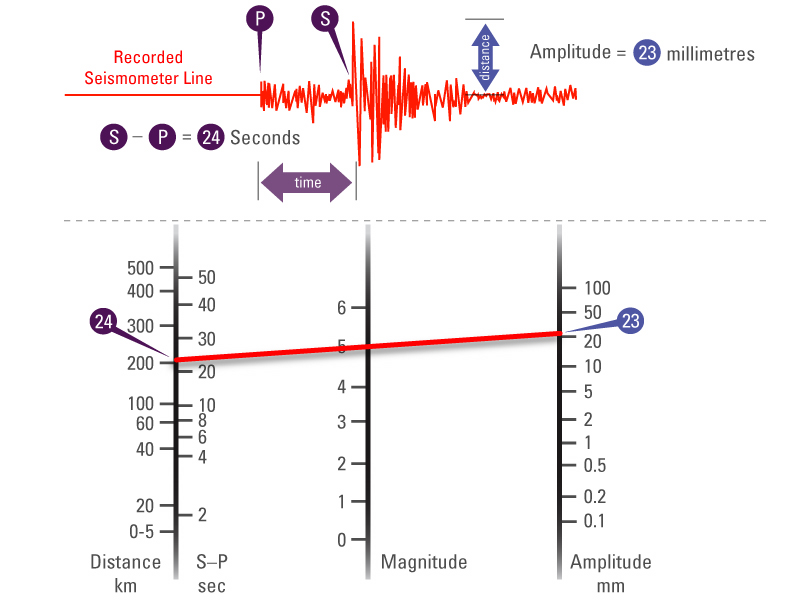 Using the Richter Scale to determine an earthquake's magnitude.
You will have to either print this diagram, or measure directly on the screen to complete the following questions:
- Verify Richter’s standard measurement that an earthquake with an amplitude of 1 mm that occurs 100 km away has a magnitude of 3.
- Verify the logarithmic nature of this scale by showing that an earthquake of 10 mm that occurs 100 km away has a magnitude of 4.
- Determine the magnitude of an earthquake that has an amplitude of 5 mm, and an S-P wave travel time of 2 seconds.
magnitude of approximately 2.3 - An earthquake of magnitude 5.4 occurs 300 km away. What will be the amplitude of the seismic waves at our receiving station?
amplitude of 20 mm
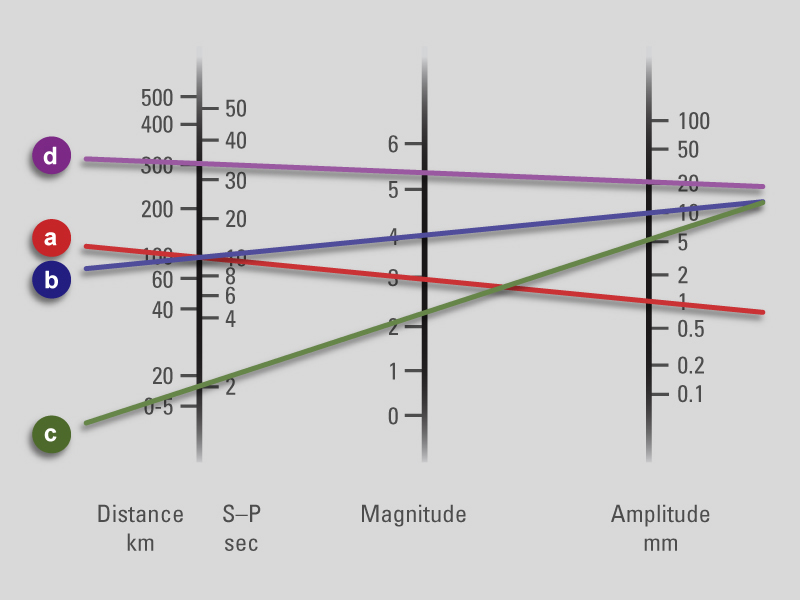 Richter Scale with solutions to questions.